SSB Screening Test Preparation: OIR and PPDT Complete Guide
The SSB Screening Test is the first major stage of the Services Selection Board (SSB) interview process. For defence aspirants appearing for SSB after qualifying through entries such as NDA, CDS, AFCAT or other eligible routes, understanding the screening process is an important part of preparation.
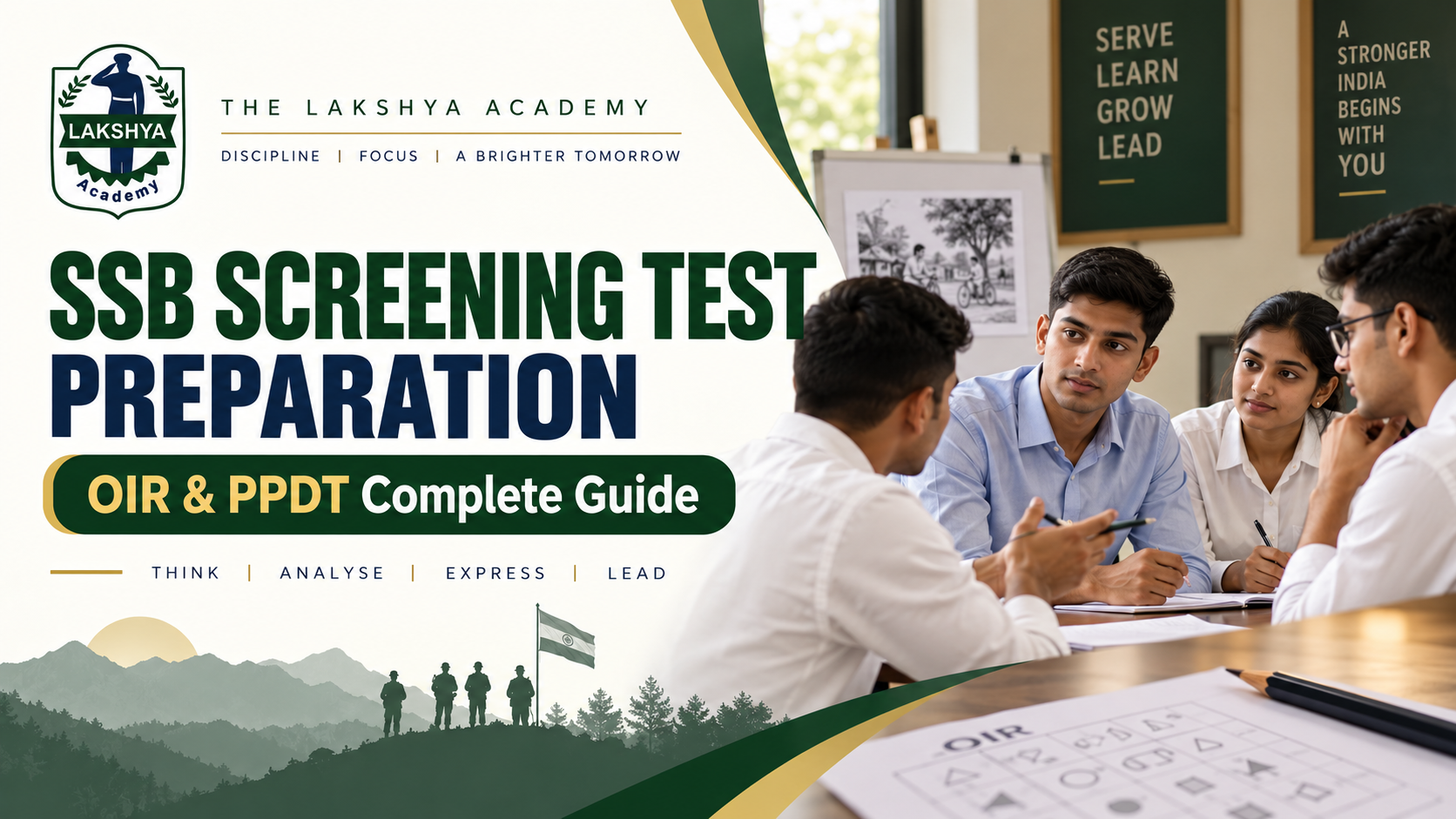
The screening stage primarily consists of the Officer Intelligence Rating (OIR) Test and the Picture Perception and Discussion Test (PPDT). SSB Screening Test Preparation requires candidates to approach both tests with clarity, speed, observation, and effective communication.
This guide by The Lakshya Academy explains OIR and PPDT preparation, the basic process, practical preparation methods and common mistakes candidates should avoid.
What Is the SSB Screening Test? A Guide to SSB Screening Test Preparation
The SSB Screening Test is conducted at the beginning of the selection process. Its purpose is to assess candidates through a combination of reasoning-based testing and a picture-based perception and group discussion exercise.
The screening process broadly includes:
Officer Intelligence Rating (OIR) Test
Picture Perception and Discussion Test (PPDT)
Candidates who clear the screening stage continue with the subsequent stages of SSB assessment.
Because the screening stage involves both individual and group performance, SSB Screening Test Preparation should not be limited to solving reasoning questions. Candidates should also develop observation, structured thinking, narration, and group communication skills to perform effectively in the screening process.
1. Officer Intelligence Rating (OIR) Test
The Officer Intelligence Rating Test, commonly known as the OIR Test, assesses a candidate through verbal and non-verbal reasoning questions.
The test is generally time-bound, making both accuracy and speed important.
What Is Asked in the OIR Test?
The exact questions can vary, but preparation commonly covers areas such as:
Verbal Reasoning
Verbal reasoning questions may include:
Analogy
Coding and decoding
Number series
Letter series
Classification
Blood relations
Direction sense
Logical reasoning
Odd one out
Basic arithmetic reasoning
Word relationships
SSB Screening Test Prepa
Non-Verbal Reasoning
Non-verbal reasoning generally involves figures, patterns and visual relationships. Common practice areas include:
Figure series
Figure analogy
Classification of figures
Odd figure
Pattern completion
Embedded figures
Mirror and water images
Spatial reasoning
Figure-based relationships
Candidates should practise different question types rather than repeatedly solving only one category.
SSB Screening Test Prepa
How to Prepare for the OIR Test
1. Understand the Question Types
Begin your SSB Screening Test Preparation by becoming familiar with commonly encountered verbal and non-verbal reasoning formats. Understanding how different questions work can help you save valuable time during practice and the actual test.
2. Work on Speed and Accuracy
OIR is a time-bound exercise. Simply knowing how to solve a question is not enough if every question takes too long.
Use timed practice sessions and gradually improve the number of questions you can attempt accurately within a fixed period.
SSB Screening Test Prepa
3. Identify Your Weak Areas
As part of SSB Screening Test Preparation, candidates should identify their strengths and weaknesses. Some candidates may be comfortable with number series but struggle with spatial reasoning, while others may perform well in verbal reasoning but take longer on figure-based questions.
Analyse your practice tests and devote additional time to weaker areas.
4. Practise Mental Calculation
Improving basic mental calculation can help with numerical reasoning questions. Practise simple calculations, patterns and number relationships without becoming dependent on lengthy written work.
5. Take Regular OIR Practice Tests
Timed practice tests help develop familiarity with pressure and improve question selection.
After every practice session, check:
Questions attempted
Correct answers
Incorrect answers
Questions that consumed excessive time
Topics requiring revision
The aim should be steady improvement rather than attempting questions randomly.
SSB Screening Test Prepa
Picture Perception and Discussion Test (PPDT)
The Picture Perception and Discussion Test (PPDT) is an important part of SSB screening.
Candidates are shown a picture for a limited period and are required to observe it, develop a story based on their perception and later participate in narration and group discussion.
PPDT requires much more than creative story writing. It involves observation, structured thinking, communication, listening and constructive participation in a group environment.SSB Screening Test Prepa
PPDT Process
PPDT can broadly be understood through four components:
Picture Observation
Candidates are shown a picture and need to observe the situation carefully.
Instead of trying to imagine an unnecessarily complicated story, concentrate on visible details and the overall situation.
Character Identification
Candidates generally note details about the characters perceived in the picture.
Observation should be quick and practical. Avoid spending excessive time on insignificant details.
SSB Screening Test Prepa
Story Writing
Based on the picture, candidates write a short story within the prescribed time.
A clear PPDT story should generally establish:
Situation → Main Character → Action → Logical Development/Outcome
The story should remain connected to what you reasonably perceive in the picture.SSB Screening Test Prepa
Individual Narration and Group Discussion
As part of SSB Screening Test Preparation, candidates narrate their stories before the group and subsequently participate in a discussion to work towards a common group story.
This stage tests the candidate’s ability to express ideas clearly while interacting effectively with others.
How to Write a Better PPDT Story
Keep the Story Connected to the Picture
Your story should originate from what you observe. Avoid creating an elaborate situation that has little connection with the picture.
Give the Story a Clear Direction
A good story should not feel like a collection of unrelated events.
A simple structure can be:
As part of SSB Screening Test Preparation, candidates can structure their PPDT story by asking: What is happening? → What does the main character do? → How does the situation develop? → What is the outcome?
Focus on Actions
Instead of repeatedly describing the character as intelligent, confident or hardworking, show meaningful actions through the story.
For example, rather than writing that a person is “a very responsible leader,” describe the steps the person takes to handle the situation.SSB Screening Test Prepa
Avoid Unrealistic Solutions
The actions taken by the main character should be practical within the context of the story.SSB Screening Test Prepa
Avoid dramatic achievements, unnecessary heroism or solutions that would be unrealistic for the situation.
Practise Within Time Limits
A good story that cannot be completed within the available time is of limited value.
Regular timed PPDT practice can improve:
Observation
Idea generation
Story structure
Writing speed
Clarity
How to Improve PPDT Narration
Narration is another area where regular practice can make a significant difference.
A candidate should be able to communicate the basic story in an organised manner.
While narrating:
Speak clearly and audibly.
Maintain a steady pace.
Keep your narration structured.
Avoid rushing through the story.
Do not unnecessarily stretch the narration.
Maintain appropriate confidence and composure.
Instead of memorising a fixed script, practise communicating your ideas naturally.
How to Approach PPDT Group Discussion
PPDT discussion can become competitive because several candidates may have different interpretations of the same picture.
Your objective should not simply be to speak the most.
Focus on meaningful participation.
Listen carefully to other candidates, present relevant points, and contribute towards developing a coherent group story.
Avoid:
Shouting over others
Repeating the same point
Interrupting continuously
Remaining completely silent
Personal arguments
Trying to dominate the group
Rejecting every alternative viewpoint
Effective participation involves both speaking and listening.
Common Mistakes in SSB Screening
Several avoidable mistakes can affect performance during screening.
Poor Time Management in OIR
Spending too much time on one difficult reasoning question can reduce the number of questions you are able to attempt.
Practising OIR Without a Timer
Untimed practice may help initially, but candidates eventually need to practise under realistic time pressure.
Creating Overly Dramatic PPDT Stories
PPDT is not a creative-writing competition. Keep your story relevant, structured and practical.
Memorising Ready-Made Stories
A memorised story may not match the picture shown during the actual test. Instead, practise developing stories from different situations.
Speaking Too Fast During Narration
Speaking rapidly can reduce clarity. Focus on delivering a concise and understandable narration.
Trying to Dominate the Discussion
Aggressive participation does not automatically mean effective participation. A candidate should contribute constructively to the group.
Daily Preparation Strategy for OIR and PPDT
Candidates can incorporate both components into their regular SSB preparation.
A practical session may include:
OIR Practice: Solve a timed set of verbal and non-verbal reasoning questions.
PPDT Observation: Observe a practice picture for a limited time and note the important details.
Story Writing: Write a complete story within the prescribed practice time.
Narration: Narrate the story aloud without reading directly from the paper.
Discussion Practice: When possible, practise PPDT discussions with other SSB aspirants.
Self-Analysis: Identify problems in reasoning speed, story structure, narration and group communication.
Consistency is more useful than doing a large amount of random practice immediately before the SSB.
OIR vs PPDT: Why You Need to Prepare for Both
OIR and PPDT require different skills.
OIR primarily requires reasoning ability, speed, accuracy and pattern recognition, while PPDT involves perception, structured thinking, communication and group interaction.
Therefore, candidates should avoid concentrating entirely on PPDT while ignoring OIR, or vice versa.
A balanced preparation strategy should include regular practice for both.
SSB Screening Preparation at The Lakshya Academy
At The Lakshya Academy, SSB preparation focuses on helping defence aspirants understand the assessment process and practise the different activities they may encounter during SSB.
Preparation can include practice and guidance related to areas such as:
OIR
PPDT
TAT
WAT
SRT
Self Description
GTO tasks
Group Discussion
GPE
Lecturette
Personal Interview
The objective of SSB preparation should be to understand the testing process, practise effectively and develop clearer communication and self-awareness rather than memorising artificial responses.
Final Words
The SSB Screening Test is an important first stage of the SSB process, and both OIR and PPDT deserve focused preparation.
For OIR, candidates should work consistently on reasoning, speed and accuracy. For PPDT, they should develop observation, structured story writing, clear narration, listening and constructive group participation.
Regular timed practice, realistic self-analysis and a balanced approach can help candidates arrive at the SSB better prepared for the screening stage.
The Lakshya Academy supports defence aspirants with structured guidance and practice for different stages of the SSB selection process.