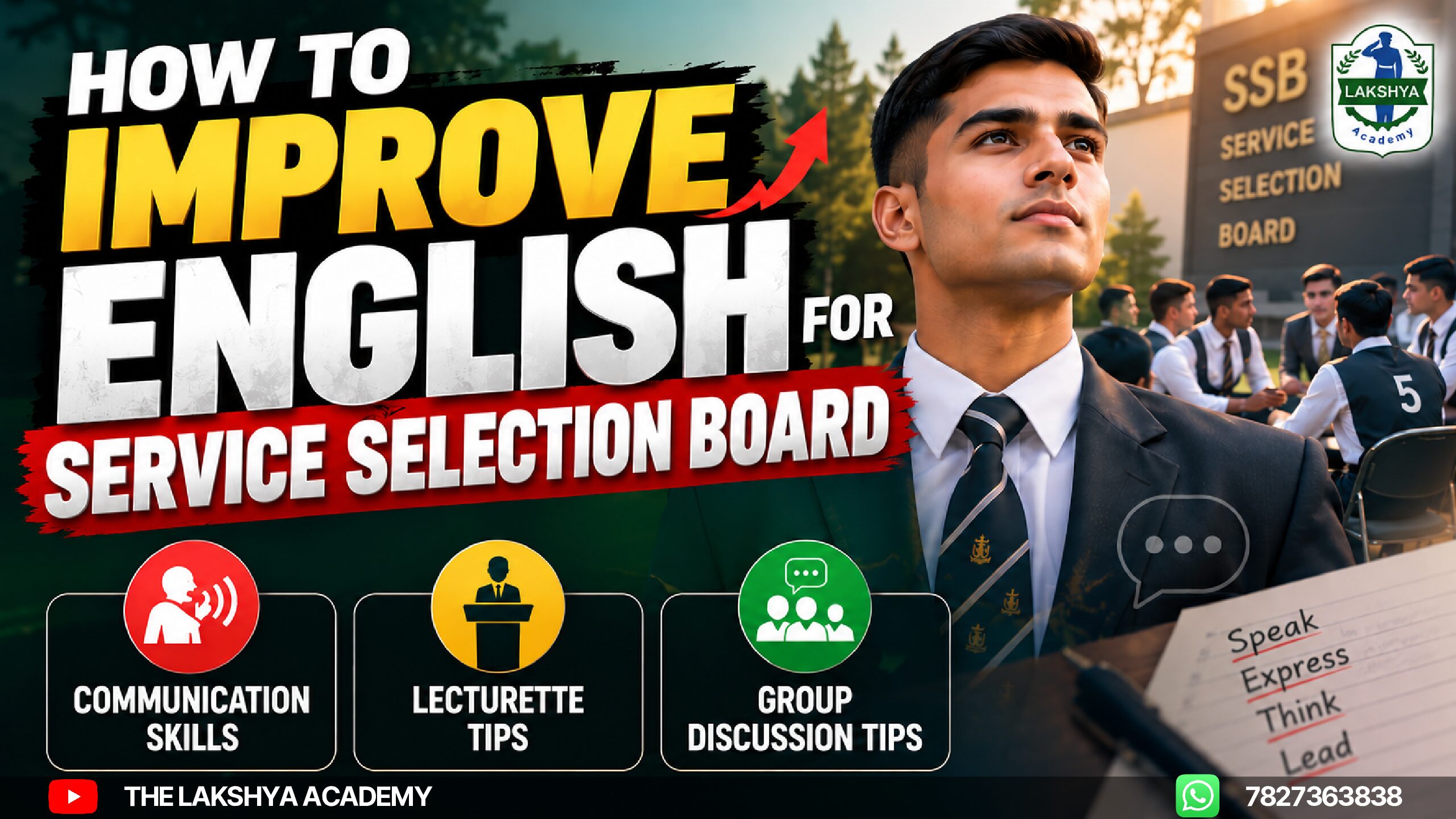
Are you preparing for the SSB Interview but struggling to communicate confidently in English? Many defence aspirants have good knowledge, leadership potential, and problem-solving abilities but find it difficult to express their thoughts during the SSB selection process. Whether it is the Personal Interview, Lecturette, Group Discussion, or Group Planning Exercise, effective communication plays an important role in presenting your ideas clearly and confidently.
The good news is that you do not need advanced English vocabulary or a foreign accent to perform well in the SSB Interview. What matters is your ability to communicate your thoughts naturally, logically, and confidently.
At The Lakshya Academy, we help NDA, CDS, AFCAT, and other defence aspirants develop the communication skills required for the SSB Interview through structured practice, interactive sessions, and expert guidance.
In this blog, we will discuss how to improve English for the SSB Interview, practical communication techniques, Lecturette preparation strategies, Group Discussion tips, and daily exercises to build confidence.
1. Why Are English Communication Skills Important for the SSB Interview?
The Services Selection Board (SSB) assesses candidates on various Officer Like Qualities (OLQs), including effective intelligence, reasoning ability, initiative, cooperation, self-confidence, and the ability to influence a group.
Communication helps candidates demonstrate many of these qualities during different assessment activities.
Good communication skills allow you to:
- Express your thoughts clearly during the Personal Interview.
- Participate confidently in Group Discussions.
- Deliver a structured and meaningful Lecturette.
- Explain your ideas effectively during Group Planning Exercises.
- Interact naturally with other candidates.
- Present logical arguments without unnecessary hesitation.
- Demonstrate confidence, clarity, and leadership potential.
However, English fluency alone does not determine SSB selection. Assessors focus on your overall personality, behaviour, judgment, and Officer Like Qualities.
Candidates should therefore focus on developing clear communication rather than memorising complicated English sentences.
2. How to Improve English Speaking Skills for SSB Interview
Improving spoken English requires regular practice, patience, and the right approach.
Here are some effective strategies to strengthen your English communication skills before the SSB Interview.
Start Thinking in English
One of the biggest challenges faced by defence aspirants is translating every sentence from Hindi into English before speaking.
This process often creates hesitation and interrupts the natural flow of conversation.
To overcome this problem, start thinking in simple English during everyday activities.
For example:
Instead of thinking in Hindi and translating it, directly form sentences such as:
- I need to complete my preparation today.
- I will practise speaking for twenty minutes.
- I should improve my current affairs knowledge.
- I want to become an officer in the Indian Armed Forces.
The objective is to make English a natural part of your daily routine.
Practise Speaking English Every Day
Consistency is more important than practising for several hours occasionally.
Dedicate at least 15–20 minutes daily to speaking English.
You can practise by:
- Introducing yourself in English.
- Describing your daily routine.
- Explaining a newspaper article.
- Speaking about your hobbies and interests.
- Discussing defence-related topics.
- Recording your voice and identifying mistakes.
Regular speaking practice gradually improves fluency, sentence formation, and confidence.
Improve Your Vocabulary Naturally
Many candidates believe that using difficult English words will impress the SSB assessors.
However, simple and meaningful communication is generally more effective than unnecessarily complicated vocabulary.
For example:
Complicated: I possess an unwavering inclination towards the defence establishment.
Simple: I want to join the Armed Forces because I am interested in leadership, responsibility, and serving the nation.
The second statement is easier to understand and sounds more natural.
Focus on learning words that help you explain your thoughts effectively.
Read English Newspapers and Articles
Reading is one of the most effective methods of improving vocabulary, grammar, and general awareness.
Defence aspirants should regularly read newspapers such as The Hindu or The Indian Express.
Focus on topics including:
- National and international affairs
- Defence and security developments
- Science and technology
- International relations
- Environmental issues
- Economic developments
- Social issues
After reading an article, try summarising it in your own words.
This exercise will improve both your English speaking ability and your preparation for Group Discussions and Lecturette.
3. How to Improve Communication Skills for SSB Personal Interview
The Personal Interview is an important part of the SSB selection process.
During this interaction, the Interviewing Officer may ask questions related to your education, family, hobbies, achievements, responsibilities, friendships, and personal experiences.
Your communication should be clear, honest, and natural.
Speak Clearly and Confidently
Avoid speaking too quickly in an attempt to demonstrate fluency.
Maintain a comfortable speaking speed so that your answers are easy to understand.
Take a brief moment to organise your thoughts when necessary.
Avoid Memorised Answers
Memorising answers to common SSB Interview questions can make your communication sound artificial.
Instead, understand the question and respond using your actual experiences.
For example, when answering:
Why do you want to join the Indian Armed Forces?
Explain your genuine motivation, interests, experiences, and understanding of military life.
Your response should reflect your personality rather than a rehearsed speech.
Improve Your Listening Skills
Effective communication involves both speaking and listening.
During the Personal Interview:
- Listen carefully to the complete question.
- Avoid interrupting the Interviewing Officer.
- Answer the question directly.
- Ask politely for clarification if required.
- Maintain natural eye contact and appropriate body language.
Remember that confidence does not mean speaking continuously. It means communicating effectively when required.
4. SSB Lecturette Preparation: How to Speak Confidently
Lecturette is an important activity conducted during the Group Testing Officer (GTO) tasks.
It assesses a candidate’s ability to organise ideas, communicate clearly, and speak confidently before a group.
In the commonly followed SSB Lecturette format, candidates receive four topics, select one, prepare for approximately three minutes, and speak for approximately three minutes.
Candidates should follow the instructions given at their particular selection centre.
How to Structure Your SSB Lecturette
A well-organised Lecturette generally contains three parts.
Introduction
Start by introducing the topic clearly.
For example:
“Good morning, everyone. Today, I would like to share my views on the importance of discipline in our daily lives.”
Main Content
Explain the topic using two or three meaningful points.
Support your arguments with relevant examples, facts, or personal observations.
Conclusion
Summarise your ideas and end with a meaningful statement.
For example:
“To conclude, discipline helps individuals remain focused, responsible, and consistent in achieving their goals.”
Important Tips for SSB Lecturette
- Select a topic you understand and can explain confidently.
- Use simple and grammatically correct English.
- Organise your ideas before beginning.
- Avoid speaking too fast or too slowly.
- Maintain natural eye contact with the group.
- Use appropriate hand gestures without overdoing them.
- Avoid unnecessary repetition.
- Practise completing your speech within the allotted time.
- Do not memorise entire speeches.
- Focus on clarity, confidence, and logical presentation.
Important Lecturette Topics for SSB Interview 2027
Defence aspirants can practise speaking on topics such as:
- Women in the Indian Armed Forces
- Artificial Intelligence and Its Impact
- Importance of Discipline
- Leadership and Teamwork
- Social Media: Advantages and Disadvantages
- India’s Defence Modernisation
- Climate Change
- Cybersecurity
- Youth and Nation Building
- Role of Technology in Education
- Make in India
- Importance of Physical Fitness
- India and International Relations
- Unemployment in India
- Time Management
Practising different topics helps candidates develop the ability to speak confidently even when they receive an unfamiliar subject.
5. SSB Group Discussion Tips: How to Communicate Effectively
Group Discussion is an important activity during the GTO assessment.
It evaluates how candidates interact with others, contribute ideas, listen to different viewpoints, and participate in a group.
Many aspirants believe that speaking the most during a Group Discussion will improve their chances of selection.
However, effective participation is more important than speaking continuously.
Understand the Topic Before Speaking
Before contributing to the discussion, understand the subject and identify its important aspects.
Avoid presenting irrelevant information merely to participate.
Present Logical and Relevant Points
Your arguments should be based on reasoning, awareness, and relevant examples.
For instance, if the discussion topic is:
Should Artificial Intelligence Be Used in Education?
You may discuss:
- Personalised learning opportunities
- Access to educational resources
- Dependence on technology
- Importance of teachers
- Ethical concerns and data privacy
Presenting balanced arguments demonstrates clarity of thought.
Respect Other Candidates
Group Discussion is not a shouting competition.
Avoid interrupting others unnecessarily or dominating the conversation.
A good participant listens carefully, respects different opinions, and contributes constructively.
Learn Useful English Phrases for Group Discussion
The following phrases can help you communicate naturally.
To introduce your opinion:
- “In my opinion…”
- “I believe that…”
- “From my perspective…”
- “I would like to highlight an important point…”
To agree with someone:
- “I agree with your point because…”
- “I would like to add something to this…”
- “That is a valid observation…”
To disagree politely:
- “I respect your opinion, but I have a different perspective.”
- “I would like to present another aspect of this issue.”
- “I understand your point; however…”
To introduce another perspective:
- “Another important factor is…”
- “We should also consider…”
- “Let us examine this from another perspective.”
Use these expressions naturally rather than repeating them mechanically.
6. Common English Communication Mistakes During SSB Interview
Many candidates make avoidable communication mistakes during SSB preparation.
Recognising these mistakes can help improve overall performance.
Using Difficult Vocabulary Unnecessarily
Complicated words do not automatically demonstrate intelligence.
Simple, precise language is more effective.
Speaking Without Understanding the Topic
Candidates sometimes begin speaking without organising their thoughts.
This can lead to repetition, irrelevant arguments, and confusion.
Trying to Dominate Group Discussions
Speaking loudly or interrupting other candidates does not necessarily demonstrate leadership.
Effective teamwork requires cooperation and mutual respect.
Memorising Lecturette Speeches
Memorised speeches may become difficult to deliver when candidates receive unfamiliar topics.
Focus on developing the ability to organise ideas spontaneously.
Ignoring Listening Skills
Candidates who concentrate only on speaking may miss important information or fail to respond appropriately to others.
Being Afraid of Grammar Mistakes
Fear of making mistakes often prevents candidates from participating.
Although grammar matters for clear communication, occasional errors should not stop you from expressing your thoughts.
Focus on communicating confidently while continuously improving accuracy.
7. Daily English Speaking Practice Plan for SSB Aspirants
A structured routine can help candidates improve their communication skills systematically.
Here is a simple 30-day English improvement plan.
Week 1: Build Basic Speaking Confidence
Focus on developing comfort with everyday English.
Practise:
- Self-introduction
- Daily routine explanation
- Reading aloud
- Basic sentence formation
- Speaking in front of a mirror
Goal: Reduce hesitation while speaking simple English sentences.
Week 2: Improve Vocabulary and Fluency
Begin practising more detailed communication.
Activities include:
- Reading newspaper editorials
- Summarising current affairs
- Learning useful vocabulary
- Recording short speeches
- Practising common interview questions
Goal: Improve sentence formation, fluency, and clarity.
Week 3: Focus on Lecturette Preparation
Practise speaking on different topics every day.
Follow a structured format:
- Introduction
- Main arguments
- Examples
- Conclusion
Record your Lecturette and evaluate your performance.
Goal: Deliver a clear, organised three-minute speech.
Week 4: Practise Group Discussions and Personal Interviews
Focus on realistic SSB communication exercises.
Activities include:
- Mock Group Discussions
- Personal Interview practice
- Current affairs discussions
- Peer feedback sessions
- Lecturette revision
Goal: Communicate confidently in interactive situations.
8. Best Daily Routine to Improve English for SSB Interview
Recommended 45-minute practice schedule
| Activity | Duration |
| Read an English newspaper | 10 minutes |
| Learn vocabulary and expressions | 5 minutes |
| Practise spoken English | 10 minutes |
| Practise Lecturette | 10 minutes |
| Group Discussion or interview practice | 10 minutes |
| Total | 45 minutes |
Following this routine consistently can help candidates become more comfortable speaking English and improve their ability to express ideas.
9. Is Fluent English Compulsory to Clear the SSB Interview?
One of the most common questions among defence aspirants is whether fluent English is compulsory for SSB selection.
The SSB Interview is not simply an English-language examination. It is a comprehensive personality assessment designed to evaluate a candidate’s suitability for officer training.
A candidate’s communication ability is important, but English fluency alone is not the deciding factor.
Candidates should understand that:
- Good communication is more important than a sophisticated accent.
- Logical thinking matters more than difficult vocabulary.
- Confidence should be supported by genuine knowledge.
- Listening and teamwork are essential.
- Officer Like Qualities remain central to the assessment.
English is particularly useful for Lecturette, Group Discussions, and communicating effectively in formal situations. Candidates should follow the language-related instructions provided during their SSB assessment.
The objective should be to develop natural, confident, and effective communication rather than trying to sound like someone else.
10. How The Lakshya Academy Helps Improve English for SSB Interview
Preparing for the SSB Interview requires more than understanding the selection process.
Candidates must practise communicating, interacting, and presenting their ideas in realistic assessment situations.
The Lakshya Academy, a defence coaching institute located in Dwarka, Delhi, provides preparation guidance for NDA, CDS, AFCAT, SSB, and AFSB aspirants.
Our SSB preparation approach focuses on helping candidates understand the assessment process and develop confidence through structured practice.
SSB Communication Skills Development
Candidates receive guidance on improving clarity of expression, confidence, and effective communication during SSB-related activities.
Lecturette Preparation
Structured Lecturette practice helps aspirants understand topic selection, speech organisation, time management, and confident delivery.
Group Discussion Practice
Interactive Group Discussion sessions help candidates practise presenting logical viewpoints, listening to others, and participating constructively.
Personal Interview Guidance
Interview preparation focuses on helping aspirants communicate their experiences, interests, responsibilities, and motivations naturally.
Guidance from Experienced Defence Mentors
The Lakshya Academy provides SSB preparation guidance with support from experienced defence mentors and retired officers who understand the expectations of the selection process.
Our objective is not to teach candidates memorised responses but to help them develop the confidence and communication skills needed to present their genuine personalities.
11. Frequently Asked Questions (FAQs)
Q1. How can I improve my English for the SSB Interview?
You can improve your English by practising speaking daily, reading newspapers, recording short speeches, participating in Group Discussions, and regularly preparing Lecturette topics.
Q2. Is English compulsory for the SSB Interview?
English is useful during various SSB activities, but fluent English alone does not determine selection. Candidates should focus on clear communication, confidence, and Officer Like
Qualities while following the instructions of their selection centre.
Q3. How can I improve my SSB Lecturette performance?
Practise speaking on different topics, organise your speech into an introduction, main content, and conclusion, and develop the habit of delivering your ideas within the allotted time.
Q4. How can I speak confidently in SSB Group Discussions?
Develop good listening habits, improve your current affairs knowledge, present relevant arguments, respect other participants, and practise participating in mock Group Discussions.
Q5. Can I improve my English for SSB in 30 days?
Thirty days of consistent practice can help improve confidence, vocabulary, and speaking fluency. However, the level of improvement depends on your starting ability and regularity of
practice.
Q6. What are the best topics for SSB Lecturette preparation?
Important practice topics include national security, artificial intelligence, women in the Armed Forces, climate change, leadership, discipline, education, technology, and current affairs.
Q7. Which academy provides SSB Interview preparation in Delhi?
The Lakshya Academy, located in Dwarka, Delhi, provides SSB and AFSB preparation guidance, including communication skills, Lecturette, Group Discussion, and Personal Interview preparation.
Conclusion
Improving English for the SSB Interview is not about learning difficult words or speaking with a perfect accent. It is about developing the ability to communicate your ideas clearly,
confidently, and naturally.
Whether you are preparing for the Personal Interview, Lecturette, Group Discussion, or Group Planning Exercise, regular speaking practice, good listening habits, logical thinking, and
current affairs knowledge can strengthen your communication skills.
Start with simple English, practise consistently, and gradually challenge yourself with more complex topics.
Remember, effective communication is not about speaking the most. It is about expressing meaningful ideas at the right time.
With structured preparation and guidance from The Lakshya Academy, defence aspirants can work towards becoming more confident and effective communicators.
Start Your SSB Interview Preparation with The Lakshya Academy
THE LAKSHYA ACADEMY
We Train Your Mind, You Take the Decisions.
Prepare for NDA, CDS, AFCAT, SSB & AFSB with experienced defence mentors.
Dwarka, New Delhi
7827363838
www.lakshyaacademy.co.in
lakshyaacademy.co.in@gmail.com