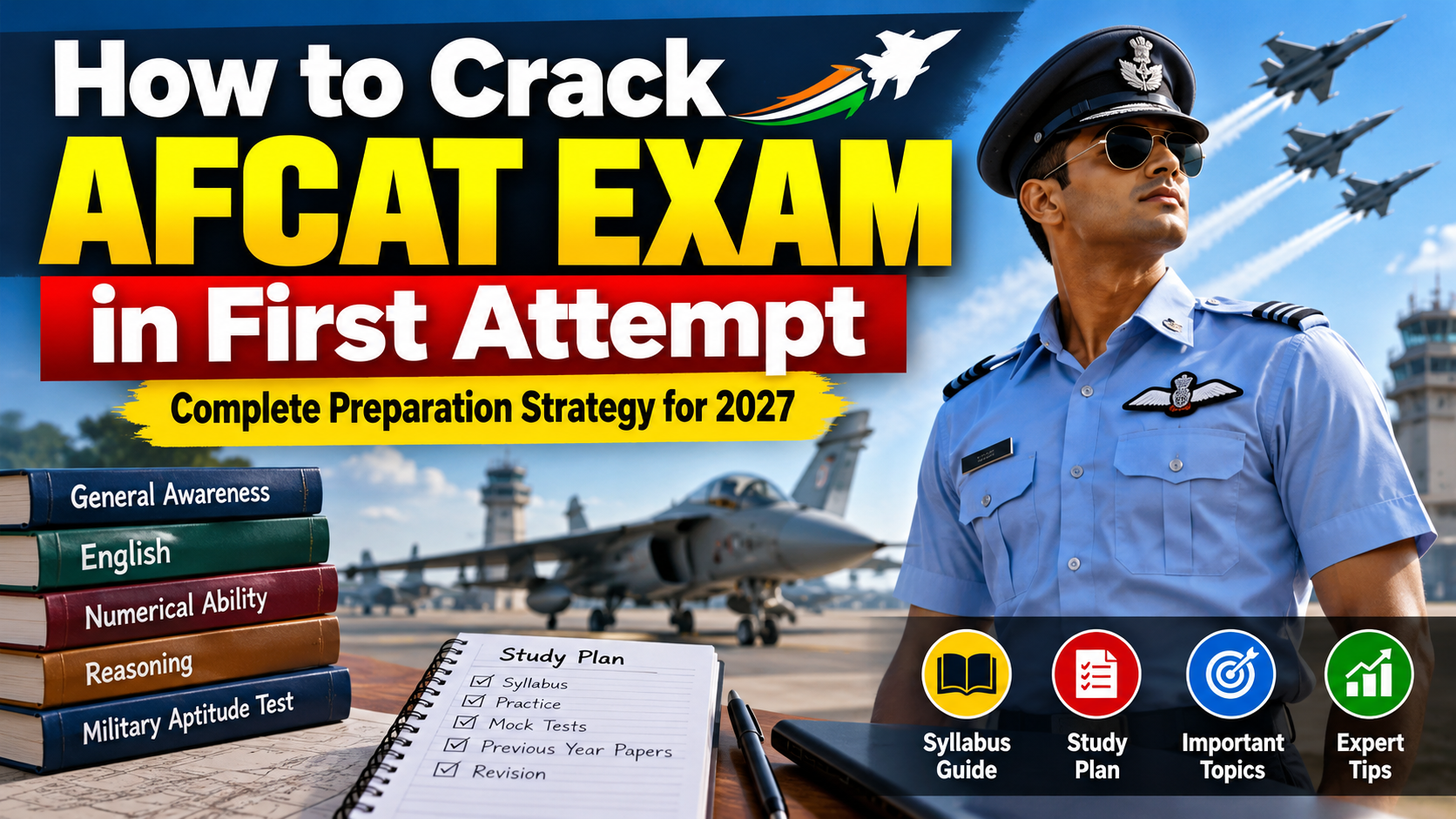
How to Crack AFCAT Exam in First Attempt . Are you dreaming of joining the Indian Air Force as an officer? The Air Force Common Admission Test (AFCAT) is one of the major
opportunities for graduates who aspire to build a career in the Indian Air Force.
Every year, thousands of candidates appear for AFCAT with the goal of joining the Flying Branch or Ground Duty Branches. However, clearing
the examination requires more than hard work. It demands a smart preparation strategy, consistent practice, effective time management, and
a clear understanding of the examination pattern.
If you are planning to appear for AFCAT 2027, starting your preparation early can significantly improve your chances of success.
The good news is that cracking AFCAT in your first attempt is achievable with disciplined preparation and the right guidance.
At The Lakshya Academy, we focus on helping defence aspirants develop strong fundamentals, improve their examination performance, and
prepare confidently for the selection process.
In this comprehensive guide, we will discuss how to crack AFCAT 2027 in your first attempt, including the syllabus, important topics,
preparation strategy, six-month study plan, and common mistakes to avoid.
What Is the AFCAT Examination? Learn How to Crack AFCAT Exam in First Attempt
The Air Force Common Admission Test (AFCAT) is conducted by the Indian Air Force to select eligible candidates for officer entry into
various branches.
Through AFCAT, candidates can apply for opportunities in:
– Flying Branch
– Ground Duty (Technical) Branch
– Ground Duty (Non-Technical) Branch
Selection generally involves the AFCAT written examination, Air Force Selection Board (AFSB) testing, medical examination, and final
merit-based selection, as applicable to the chosen entry.
Candidates applying for certain Technical Branch entries may also be required to appear for the Engineering Knowledge Test (EKT),
depending on the applicable notification.
Before starting preparation, candidates should check the official eligibility criteria, including age, educational qualifications, and
branch-specific requirements.
AFCAT Exam Pattern 2027
Understanding the AFCAT examination pattern is the first step toward effective preparation.
The following is based on the established AFCAT examination structure. Candidates should verify any changes in the official 2027
notification.
AFCAT Written Examination Pattern
– Total Questions: 100
– Maximum Marks: 300
– Exam Duration: 2 Hours
– Question Type: Multiple Choice Questions
– Correct Answer: +3 Marks
– Incorrect Answer: −1 Mark
– Unattempted Question: 0 Marks
– Examination Mode: Online
The AFCAT written examination consists of four major sections:
1. General Awareness
2. Verbal Ability in English
3. Numerical Ability
4. Reasoning and Military Aptitude Test
The examination tests candidates’ knowledge, analytical thinking, problem-solving ability, and time management.
Since negative marking is applicable, candidates should prioritize accuracy rather than attempting questions through random guessing.
AFCAT Syllabus 2027: Important Subjects and Topics
A clear understanding of the AFCAT syllabus helps candidates identify important areas and prepare systematically.
1. General Awareness
General Awareness is an important section of AFCAT preparation because it evaluates candidates’ knowledge of national and international
developments.
Important Topics:
– Indian History
– Indian Geography
– Indian Polity
– Indian Economy
– General Science
– Current Affairs
– Defence-Related News
– Indian Armed Forces
– Sports
– Awards and Honours
– Important Organizations
– Art and Culture
Preparation Strategy:
Read current affairs regularly and focus on defence-related developments.
Prepare short notes on important national and international events. Revise static General Knowledge topics alongside current affairs.
Pay special attention to Indian Air Force-related developments, military exercises, defence technology, and important appointments.
2. Verbal Ability in English
English is a major component of the AFCAT examination. Candidates with strong vocabulary and grammar fundamentals can improve their
performance through consistent practice.
Important Topics:
– Reading Comprehension
– Synonyms and Antonyms
– Idioms and Phrases
– Error Detection
– Sentence Completion
– Fill in the Blanks
– One-Word Substitution
– Sentence Rearrangement
– Vocabulary
– Grammar
– Cloze Test
Preparation Strategy:
Develop a habit of reading English newspapers, articles, and editorials.
Learn new vocabulary daily and revise grammar rules regularly.
Practice previous-year AFCAT English questions to understand the nature of questions asked in the examination.
Expert Tip: Instead of memorizing hundreds of words without revision, focus on learning a manageable number of words daily and using them
in sentences.
3. Numerical Ability
Numerical Ability evaluates candidates’ mathematical understanding and calculation skills.
The AFCAT Numerical Ability syllabus generally focuses on school-level mathematical concepts.
Important Topics:
– Number System
– Decimal Fractions
– Simplification
– Percentage
– Ratio and Proportion
– Average
– Profit and Loss
– Simple and Compound Interest
– Time and Work
– Time, Speed and Distance
– Boats and Streams
– Mixture and Allegation
– Mensuration
– Probability
– Number Series
Preparation Strategy:
Start with fundamental mathematical concepts and gradually move toward examination-level questions.
Practice calculation techniques and mathematical formulas regularly.
Focus on improving accuracy and solving questions within a limited time.
Candidates who consider Mathematics their weak subject should dedicate additional time to basic arithmetic.
4. Reasoning and Military Aptitude Test
The Reasoning and Military Aptitude section evaluates logical thinking, analytical ability, and spatial reasoning.
Important Topics:
– Verbal Reasoning
– Non-Verbal Reasoning
– Analogy
– Classification
– Number Series
– Coding-Decoding
– Blood Relations
– Direction Sense
– Venn Diagrams
– Figure Series
– Pattern Completion
– Embedded Figures
– Spatial Ability
Preparation Strategy:
Practice verbal and non-verbal reasoning questions daily.
Learn to identify patterns, relationships, and logical sequences quickly.
Use timed practice sessions to improve speed and decision-making ability.
How to Crack AFCAT 2027 in Your First Attempt
Cracking AFCAT on the first attempt requires a balanced approach covering all four sections of the examination.
Here are some effective preparation strategies.
1. Understand the Complete AFCAT Syllabus
Before starting your preparation, thoroughly understand the official syllabus.
Divide the syllabus into smaller topics and prepare a checklist.
Identify subjects in which you are confident and areas that require additional attention.
This helps you distribute your study time effectively.
2. Create a Realistic Study Timetable
A well-structured timetable is essential for consistent preparation.
Candidates should allocate sufficient time to all four subjects while giving extra attention to weaker areas.
For example:
– English: 1 Hour
– General Awareness: 1 Hour
– Numerical Ability: 1 Hour
– Reasoning: 1 Hour
– Revision and Practice: 30 Minutes
This timetable provides approximately four and a half hours of focused preparation.
Candidates can adjust the schedule according to their college, work, or other commitments.
3. Strengthen Your Basic Concepts
Many aspirants begin solving advanced questions without understanding the fundamentals.
This approach often leads to confusion and unnecessary mistakes.
Start with basic concepts in Mathematics, English Grammar, and Reasoning.
Once your fundamentals are clear, gradually move toward more challenging questions.
4. Focus on High-Priority Topics
Not every topic requires the same amount of preparation time.
Identify important topics through the syllabus and previous-year question analysis.
Give additional attention to areas where you can improve your accuracy and speed.
However, avoid completely ignoring any major section because the distribution of questions can vary.
5. Solve AFCAT Previous-Year Questions
Previous-year questions are among the most useful preparation resources.
They help candidates understand:
– Common question patterns
– Important concepts
– Difficulty levels
– Time management requirements
– Frequently tested areas
Practice previous-year and memory-based AFCAT questions regularly.
Review the solutions carefully instead of focusing only on the final answers.
6. Attempt Mock Tests Regularly
Mock tests help candidates evaluate their preparation and become familiar with examination conditions.
Start with sectional tests and gradually move toward full-length mock tests.
After every test, analyze:
– Total Questions Attempted
– Correct Answers
– Incorrect Answers
– Accuracy Percentage
– Time Taken
– Weak Topics
Use this analysis to improve your preparation.
7. Improve Speed and Accuracy
AFCAT consists of 100 questions to be solved within 120 minutes.
Candidates must balance speed with accuracy.
Practice timed questions regularly and avoid spending too much time on difficult problems.
Remember that random guessing can negatively affect your final score because of negative marking.
8. Revise Consistently
Revision is essential for remembering formulas, vocabulary, current affairs, and reasoning techniques.
Prepare short notes and revise them weekly.
Regular revision improves retention and reduces last-minute preparation pressure.
AFCAT 2027 Six-Month Preparation Strategy
A six-month study plan can help aspirants prepare systematically and improve their chances of clearing the written examination.
Month 1: Build a Strong Foundation
Focus Areas:
– Basic English Grammar
– Vocabulary
– Arithmetic Fundamentals
– Basic Reasoning
– Static General Knowledge
Preparation Goals:
Understand the syllabus, develop a daily study routine, and strengthen fundamental concepts.
Begin reading current affairs regularly.
Month 2: Complete Important Topics
Focus Areas:
– Synonyms and Antonyms
– Idioms and Phrases
– Percentage and Ratio
– Profit and Loss
– Coding-Decoding
– Indian History and Geography
Preparation Goals:
Practice topic-wise questions and identify weak areas.
Take weekly sectional tests to evaluate progress.
Month 3: Strengthen Numerical Ability and Reasoning
Focus Areas:
– Time and Work
– Time, Speed and Distance
– Simple and Compound Interest
– Number Series
– Non-Verbal Reasoning
– Spatial Ability
Preparation Goals:
Improve calculation speed and logical reasoning skills.
Continue English vocabulary and General Awareness preparation.
Month 4: Complete the Syllabus
Focus Areas:
– Remaining English Topics
– Remaining Numerical Ability Topics
– Advanced Reasoning Practice
– Defence Current Affairs
– Static GK Revision
Preparation Goals:
Complete the syllabus and start solving mixed-topic practice sets.
Attempt full-length mock tests to identify performance gaps.
Month 5: Focus on Mock Tests and Previous-Year Questions
Preparation Strategy:
– Attempt 2–3 full-length mock tests every week.
– Solve previous-year AFCAT questions.
– Revise important formulas.
– Improve vocabulary.
– Review General Awareness notes.
– Analyze mistakes after every mock test.
Preparation Goals:
Improve speed, accuracy, and confidence under examination conditions.
Month 6: Final Revision and Examination Practice
The final month should focus on revision and performance improvement.
Preparation Strategy:
– Attempt regular full-length mock tests.
– Revise important topics.
– Practice high-priority questions.
– Review previous mistakes.
– Focus on accuracy and time management.
– Avoid unnecessary last-minute changes to your preparation strategy.
Preparation Goals:
Develop a confident and effective approach for the AFCAT written examination.
Best Daily Study Plan for AFCAT 2027
A consistent daily routine can help candidates complete the syllabus and improve examination performance.
Morning Session
– 30 Minutes: Current Affairs
– 30 Minutes: Static General Knowledge
Afternoon Session
– 60 Minutes: Numerical Ability
– 45 Minutes: Reasoning
Evening Session
– 60 Minutes: English Grammar and Vocabulary
– 30 Minutes: Previous-Year Questions and Revision
This study schedule provides approximately four hours and fifteen minutes of preparation.
Candidates should modify the timetable based on their personal learning speed and available time.
How to Score High in AFCAT 2027
Scoring well in AFCAT requires smart question selection and strong accuracy.
Focus on Your Strongest Sections
During preparation, identify the sections where you consistently perform well.
Strengthen these areas while gradually improving weaker subjects.
Avoid Negative Marking
AFCAT deducts one mark for every incorrect answer.
Therefore, candidates should avoid blind guessing.
For example, consider the following mock test performance:
– Questions Attempted: 80
– Correct Answers: 65
– Incorrect Answers: 15
– Marks Obtained from Correct Answers: 195
– Negative Marks: 15
– Final Score: 180/300
This example shows how accuracy affects the final score.
The score is illustrative and should not be treated as an official AFCAT 2027 cutoff.
Use Time Management Techniques
Do not spend excessive time on a single question.
Start with questions you can answer confidently and return to difficult questions later if time permits.
Practice Regularly
Daily practice helps improve familiarity with examination patterns.
Focus on quality practice rather than attempting a large number of questions without reviewing mistakes.
Common Mistakes to Avoid While Preparing for AFCAT 2027
Many candidates struggle to clear AFCAT because of avoidable preparation mistakes.
Ignoring General Awareness
Some aspirants focus heavily on Mathematics and Reasoning while neglecting General Awareness.
Solution: Dedicate time to current affairs and static GK every day.
Not Practicing English Regularly
Vocabulary and grammar require consistent revision.
Solution: Read English content daily and practice grammar-based questions.
Depending Only on Mock Tests
Mock tests alone cannot replace conceptual preparation.
Solution: Combine theory, topic-wise practice, previous-year questions, and mock tests.
Studying Without Revision
Candidates may forget previously learned concepts without regular revision.
Solution: Follow a weekly revision schedule.
Ignoring Negative Marking
Attempting too many uncertain questions can reduce the final score.
Solution: Develop a balanced approach based on accuracy and logical elimination.
Preparing Only for the Written Examination
Clearing AFCAT is an important step, but it is not the complete officer selection process.
Solution: Understand the AFSB selection process and develop communication skills, general awareness, and officer-like qualities alongside
written examination preparation.
AFCAT 2027 Preparation: How to Get Ready for AFSB
Candidates who qualify for the AFCAT written examination and meet the relevant requirements proceed to the Air Force Selection Board
process.
AFSB evaluates candidates through various psychological, group, and personal assessment activities.
Preparation areas include:
– Officer Intelligence Rating (OIR) Tests
– Picture Perception and Discussion Test (PPDT)
– Psychological Tests
– Group Testing Officer (GTO) Tasks
– Personal Interview
– Communication Skills
– General Awareness
– Personality Development
Candidates applying for the Flying Branch may also need to qualify for the Computerised Pilot Selection System (CPSS), as applicable.
The purpose of AFSB preparation should be to develop genuine self-awareness, confidence, teamwork, communication, and decision-making
skills rather than memorizing artificial responses.
Best Books for AFCAT 2027 Preparation
Choosing appropriate study material is important for effective preparation.
Some useful resources include:
1. AFCAT Preparation Guide by Arihant
Useful for understanding the syllabus and practicing examination-oriented questions.
2. Objective General English by S.P. Bakshi
A useful resource for grammar, vocabulary, and English practice.
3. Quantitative Aptitude by R.S. Aggarwal
Helpful for strengthening basic arithmetic and calculation skills.
4. A Modern Approach to Verbal & Non-Verbal Reasoning by R.S. Aggarwal
Useful for practicing logical reasoning and non-verbal aptitude questions.
5. NCERT Books
NCERT textbooks can help strengthen fundamentals in History, Geography, Science, and Mathematics.
Candidates should also use reliable current affairs resources and AFCAT previous-year or memory-based practice papers.
Why Choose The Lakshya Academy for AFCAT 2027 Preparation?
Choosing the right coaching institute can help aspirants prepare systematically and stay consistent throughout their defence examination journey.
The Lakshya Academy, located in Dwarka, Delhi, provides preparation guidance for AFCAT, NDA, CDS, and SSB examinations.
Our approach focuses on strengthening concepts, developing examination skills, and helping aspirants prepare confidently for defence
selection.
1. Structured AFCAT Preparation
A structured preparation approach helps students cover the syllabus and revise important concepts systematically.
2. Focus on Fundamental Concepts
The Lakshya Academy emphasizes conceptual clarity in English, Mathematics, General Awareness, and Reasoning.
3. Examination-Oriented Practice
Students are encouraged to practice previous-year questions, objective exercises, and examination-level questions.
4. Guidance for AFSB Preparation
The academy also provides SSB and AFSB preparation guidance to help candidates understand the officer selection process.
5. Defence-Focused Learning Environment
Preparing alongside other defence aspirants can help students maintain discipline, consistency, and motivation.
6. Preparation for Multiple Defence Examinations
Students interested in other defence entries can also explore preparation options for NDA, CDS, and SSB.
For candidates searching for AFCAT coaching in Delhi, AFCAT preparation classes in Dwarka, or guidance for the AFCAT 2027 examination, The
Lakshya Academy is an option worth exploring.
Frequently Asked Questions About AFCAT 2027
Q1. Can I crack AFCAT 2027 in my first attempt?
Yes. With a clear understanding of the syllabus, consistent preparation, regular mock tests, and effective revision, candidates can
improve their chances of clearing AFCAT in their first attempt.
Q2. How many months are required to prepare for AFCAT 2027?
A preparation period of three to six months can be useful for many candidates. The actual time required depends on existing knowledge,
study consistency, and individual strengths and weaknesses.
Q3. Is AFCAT difficult to crack?
The examination can be competitive, but a structured preparation strategy and regular practice can help candidates improve their
performance.
Q4. Which subjects are most important for AFCAT 2027?
English, General Awareness, Numerical Ability, and Reasoning and Military Aptitude are all important parts of the AFCAT syllabus.
Q5. How many hours should I study daily for AFCAT?
Approximately three to five hours of focused daily study can be a practical preparation target, depending on your current level and
available time.
Q6. Is Mathematics compulsory in AFCAT?
Yes. Numerical Ability is a component of the AFCAT written examination for candidates taking AFCAT.
Q7. Can I prepare for AFCAT without coaching?
Yes. Self-study can be effective with reliable study materials, regular practice, and disciplined preparation. Coaching can provide
additional structure and guidance for candidates who need it.
Q8. What is the marking scheme for AFCAT?
Under the established AFCAT pattern, candidates receive three marks for every correct answer and lose one mark for every incorrect answer.
Q9. Is AFSB compulsory after clearing AFCAT?
Candidates shortlisted through AFCAT must complete the applicable AFSB selection process and subsequent requirements to be considered for
final selection.
Q10. Where can I find AFCAT coaching in Delhi?
Candidates looking for AFCAT coaching in Delhi can explore the preparation programs offered by The Lakshya Academy in Dwarka.
Conclusion
Cracking AFCAT 2027 in your first attempt is an achievable goal for candidates who follow a disciplined and well-planned preparation
strategy.
The key to success is understanding the syllabus, strengthening basic concepts, practicing previous-year questions, and regularly
evaluating performance through mock tests.
Candidates should focus on all four sections of the examination while improving accuracy, speed, and time management.
Remember that clearing the written examination is only one stage of becoming an officer in the Indian Air Force. Candidates should also
prepare for the AFSB selection process and develop the confidence, communication skills, and leadership qualities expected of future
officers.
At The Lakshya Academy, our mission is to guide defence aspirants through structured preparation and help them move closer to their dream
of serving the nation.
Start your AFCAT 2027 preparation today, stay consistent, and work toward your goal of joining the Indian Air Force.
Start Your AFCAT 2027 Journey with The Lakshya Academy
The Lakshya Academy – NDA | CDS | AFCAT | SSB Preparation
Location: Dwarka, New Delhi
Contact: 7827363838
Website: www.lakshyaacademy.co.in Our Motto: We train your mind, you take the decisions.