The Air Force Common Admission Test is one of the most popular defence examinations for graduates who aspire to join the Indian Air Force as commissioned officers. A large number of candidates appear for the examination, but successful preparation begins with two essential steps: understanding the syllabus and following a practical subject-wise strategy.
Many aspirants start collecting books, watching random videos and attempting questions without knowing which areas require priority. This creates confusion and makes revision difficult. A structured AFCAT Syllabus and Subject-Wise Preparation Strategy helps candidates use their time efficiently, strengthen weak areas and improve accuracy through focused practice.
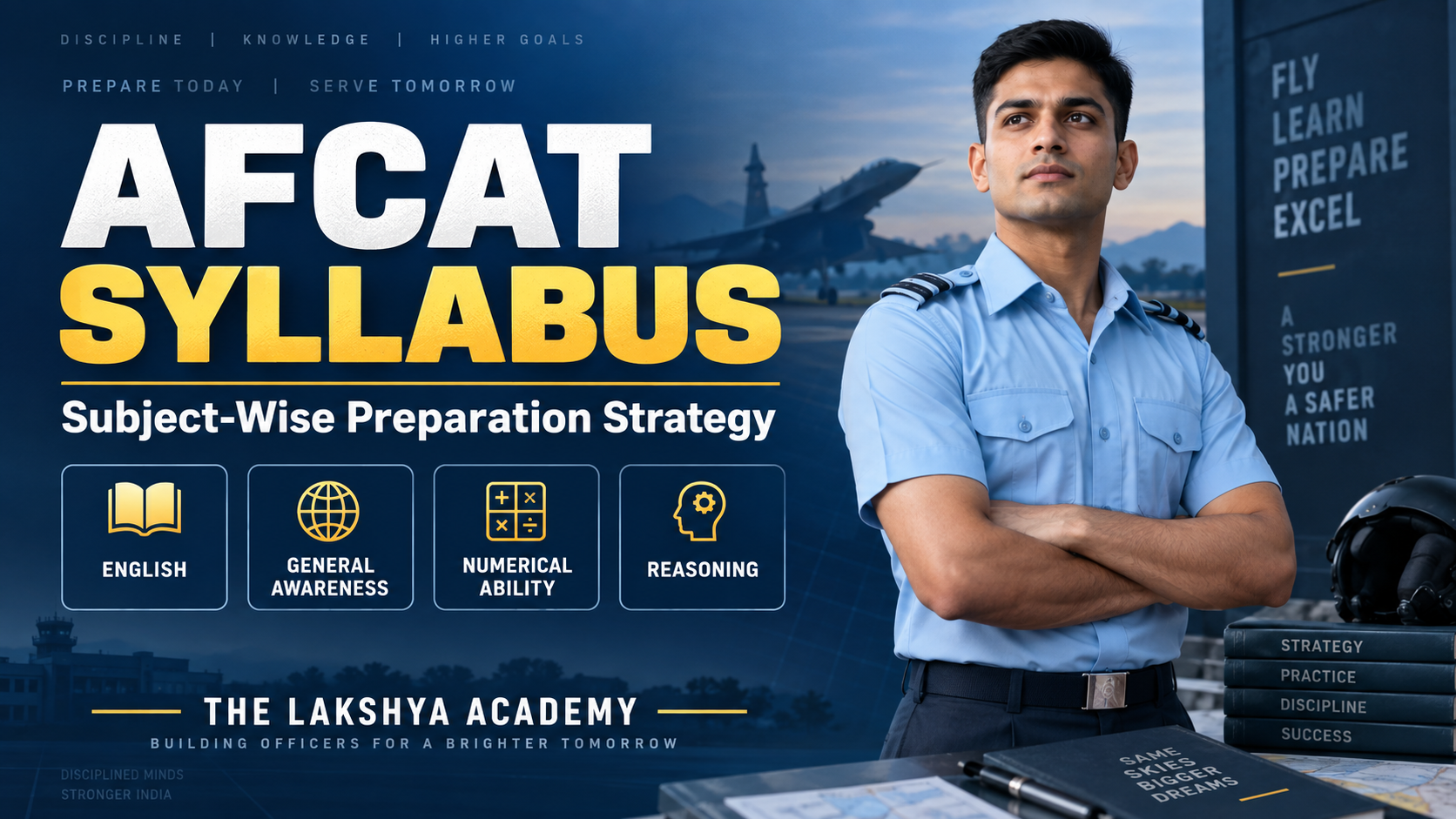
This guide explains the AFCAT syllabus and subject-wise preparation strategy for English, General Awareness, Numerical Ability, and Reasoning and Military Aptitude. Candidates should always check the latest notification and instructions on the official AFCAT website because the examination scheme, eligibility requirements or administrative details may be updated.
Understanding the AFCAT Syllabus and Subject-Wise Preparation Strategy
The AFCAT Syllabus and Subject-Wise Preparation Strategy should begin with a clear understanding of the written examination. The AFCAT written examination evaluates a candidate’s language ability, awareness, numerical skills, logical thinking and military aptitude. The paper has traditionally included 100 objective-type questions carrying 300 marks, with a duration of two hours. Correct answers generally receive three marks, while one mark is deducted for every incorrect answer. Candidates should confirm the current pattern from the official notification applicable to their examination cycle.
The major sections are:
General Awareness
Verbal Ability in English
Numerical Ability
Reasoning and Military Aptitude Test
AFCAT Syllabus and Subject-Wise Preparation Strategy
Since negative marking can affect the final score, the AFCAT Syllabus and Subject-Wise Preparation Strategy should focus on both speed and accuracy. Candidates should not merely aim to attempt the maximum number of questions; they should learn to recognise which questions can be solved confidently within the available time.
AFCAT English Syllabus
The English section tests vocabulary, grammar, comprehension and the ability to use the language correctly. Questions may be based on:
Reading comprehension
Error detection
Sentence completion
Fill in the blanks
Synonyms and antonyms
Vocabulary usage
Idioms and phrases
One-word substitution
Sentence improvement
Sentence rearrangement
Cloze test
Analogy and verbal ability
AFCAT Syllabus and Subject-Wise Preparation Strategy
AFCAT English Preparation Strategy
As part of the AFCAT Syllabus and Subject-Wise Preparation Strategy, begin by strengthening the basic rules of grammar. Focus on parts of speech, subject–verb agreement, articles, prepositions, tenses, pronouns, modifiers and conjunctions. Instead of memorising rules in isolation, solve examples after learning every concept.
Develop a daily vocabulary routine. Learn a manageable number of words along with their meanings, synonyms, antonyms and usage in sentences. Revising old words is more valuable than collecting a large list that you cannot recall.
As part of the AFCAT Syllabus and Subject-Wise Preparation Strategy, read editorials, defence-related articles and quality English passages regularly. Reading improves comprehension, vocabulary and sentence structure simultaneously. While solving comprehension questions, identify the central idea, tone and supporting details rather than relying on assumptions.
Practise previous questions and timed sectional tests. Maintain a grammar and vocabulary notebook containing frequently confused words, recurring errors, idioms and new expressions. Revise this notebook every week.
AFCAT General Awareness Syllabus
General Awareness covers both static knowledge and current developments. The broad areas may include:
History
Geography
Indian Polity and Constitution
Economics
General Science
Environment and ecology
Art and culture
Sports
National and international organisations
Defence exercises and military affairs
Important personalities, awards and honours
Current affairs
AFCAT Syllabus and Subject-Wise Preparation Strategy
AFCAT General Awareness Preparation Strategy
As part of the AFCAT Syllabus and Subject-Wise Preparation Strategy, divide General Awareness into static subjects and current affairs. For static GK, prepare concise notes for history, geography, polity, economics and science. Do not study every topic at the depth required for a civil services examination. Focus on concepts, facts and themes that match the level and nature of AFCAT questions.
As part of the AFCAT Syllabus and Subject-Wise Preparation Strategy, defence awareness deserves special attention. Candidates should understand the basic structure of the Indian Armed Forces, commands, important aircraft and missile systems, military exercises, ranks, major defence appointments and significant developments. Always verify time-sensitive facts through reliable and official sources.
As part of the AFCAT Syllabus and Subject-Wise Preparation Strategy, follow a consistent monthly source instead of switching repeatedly. Cover important national and international events, defence news, awards, sports, science and technology, appointments, government initiatives and major reports. Make short revision notes and revise them multiple times.
General Awareness is difficult to improve through last-minute reading alone. Regular revision and quiz-based recall are essential. Attempt short quizzes several times a week and maintain an error list for facts you repeatedly forget.
AFCAT Numerical Ability Syllabus
Numerical Ability generally tests school-level mathematical concepts and the ability to solve them quickly. Important areas include:
Number system
Decimal fractions
Simplification
Ratio and proportion
Percentage
Average
Profit and loss
Simple and compound interest
Time and work
Time, speed and distance
Problems on trains
Boats and streams
Mixture and allegation
Probability
Area and perimeter
Elementary mensuration
Data interpretation
Candidates must check the latest official syllabus for the exact scope of topics applicable to their examination.
AFCAT Syllabus and Subject-Wise Preparation Strategy
AFCAT Numerical Ability Preparation Strategy
As part of the AFCAT Syllabus and Subject-Wise Preparation Strategy, start with arithmetic fundamentals. Percentage, ratio, average, profit and loss, time and work, and speed-distance concepts form the base for many questions. Learn the logic behind formulas before trying shortcuts.
Improve calculation speed by practising multiplication tables, squares, cubes, fractions-to-percentages and common approximations. Faster calculation can save valuable time, but accuracy must remain the priority.
After completing a concept, solve questions in three stages. Begin with basic untimed problems, move to examination-level questions and finally attempt a timed set. This gradual approach builds confidence without sacrificing conceptual clarity.
As part of the AFCAT Syllabus and Subject-Wise Preparation Strategy, create a formula notebook and revise it frequently. Record not only formulas but also the conditions in which they apply. When analysing mistakes, determine whether the error occurred because of a weak concept, an incorrect formula, a calculation mistake or poor time management.
Do not avoid mathematics because it appears difficult. Even candidates with weak basics can improve through daily practice. A focused session every day is more effective than one long mathematics session every week.
AFCAT Reasoning and Military Aptitude Syllabus
This section evaluates logical ability, observation, pattern recognition and spatial understanding. Common question types include:
Verbal reasoning
Analogy
Classification
Number and letter series
Coding and decoding
Blood relations
Direction sense
Venn diagrams
Logical sequence
Syllogism
Non-verbal reasoning
Figure classification
Embedded figures
Mirror and water images
Paper folding and cutting
Spatial ability and pattern completion
AFCAT Syllabus and Subject-Wise Preparation Strategy
Reasoning and Military Aptitude Preparation Strategy
Reasoning improves primarily through practice. First understand the method used for each question type, and then solve multiple variations. Do not memorise answers; learn to recognise patterns and eliminate unsuitable options.
For series, analogy and classification questions, look for the simplest logical relationship first. For direction and blood-relation problems, draw small diagrams instead of solving everything mentally. For non-verbal reasoning, observe rotation, symmetry, position, number of elements and changes in shape.
Use timed practice sets after building basic familiarity. If a question takes too long, mark it for review and move ahead. A strong reasoning score depends on choosing the correct method quickly, not merely reaching the answer eventually.
Maintain a record of recurring question types and errors. Revisiting these questions after a few days helps convert short-term understanding into reliable examination performance.AFCAT Syllabus and Subject-Wise Preparation Strategy
How to Create an Effective AFCAT Study Plan
A preparation plan should be based on your current level rather than copied blindly from another candidate. Begin with a diagnostic mock test to identify strong and weak sections. Then distribute study time according to the improvement required.
A balanced daily routine may include:
One session for learning or revising a core subject
One shorter session for question practice
Daily vocabulary and current-affairs revision
Formula or error-notebook revision
A timed sectional test on selected days
Weekly preparation should include syllabus revision, previous-year questions and at least one test followed by detailed analysis. As the examination approaches, gradually increase the frequency of full-length mock tests.
AFCAT Syllabus and Subject-Wise Preparation Strategy
Three-Phase AFCAT Preparation Strategy
Phase 1: Build Concepts
Complete the fundamental concepts of every section. Create short notes, formula sheets and vocabulary lists. During this phase, focus on understanding and accuracy rather than attempting questions at maximum speed.
Phase 2: Practise and Improve
Solve topic-wise questions and previous papers. Identify recurring weaknesses and revise them. Begin sectional tests and learn to manage the time allotted to each part of the paper.
Phase 3: Test and Revise
Attempt full-length mocks in an examination-like environment. Avoid interruptions and follow a fixed time limit. Analyse every mock carefully and revise only from reliable notes, marked questions and error records.
Importance of Previous-Year Questions and Mock Tests
Previous-year questions help candidates understand the type, level and recurring themes of the examination. They also reveal whether a topic has been prepared at the required depth. However, memorising answers without understanding the method provides little benefit.
Mock tests help improve stamina, question selection, accuracy and time management. After every test, classify mistakes into four categories: conceptual errors, calculation errors, careless mistakes and questions left because of poor time allocation. This analysis should guide the next week’s preparation.
Common Mistakes AFCAT Aspirants Should Avoid
Beginning preparation without reviewing the syllabus
Using too many books, channels or current-affairs sources
Ignoring weak subjects for long periods
Learning shortcuts without understanding concepts
Attempting mocks without analysing mistakes
Guessing excessively despite negative marking
Postponing revision until the final weeks
Studying current affairs without making short revision notes
Focusing only on the written examination and ignoring overall officer-oriented development
How The Lakshya Academy Supports AFCAT Aspirants
Preparing independently can become confusing when students do not know what to study, how deeply to study or how to evaluate their progress. The Lakshya Academy provides AFCAT aspirants with structured academic guidance, concept-oriented teaching, regular practice and a disciplined preparation environment in Delhi.
The aim is to help students understand the examination, strengthen their fundamentals and build the confidence needed to perform effectively. Aspirants can benefit from planned syllabus coverage, doubt support, practice questions, tests and mentoring while continuing their personal revision and self-study.
Coaching can provide direction, but consistent effort remains essential. The most successful approach combines expert guidance with daily self-study, honest test analysis and repeated revision.
Final Words
The AFCAT syllabus is manageable when it is divided into subjects and completed through a structured plan. English requires daily reading and vocabulary revision. General Awareness demands consistency and repeated recall. Numerical Ability improves through concept-building and calculation practice, while Reasoning and Military Aptitude require exposure to varied question patterns.
Do not wait for the perfect timetable or resource. Begin with the official syllabus, choose limited study material and work consistently. Regular practice, strategic revision and accurate mock-test analysis can make your preparation more focused and effective.
With the right guidance and disciplined effort, aspirants can move closer to their goal of joining the Indian Air Force. The Lakshya Academy is committed to supporting defence aspirants with structured preparation and a serious learning environment.