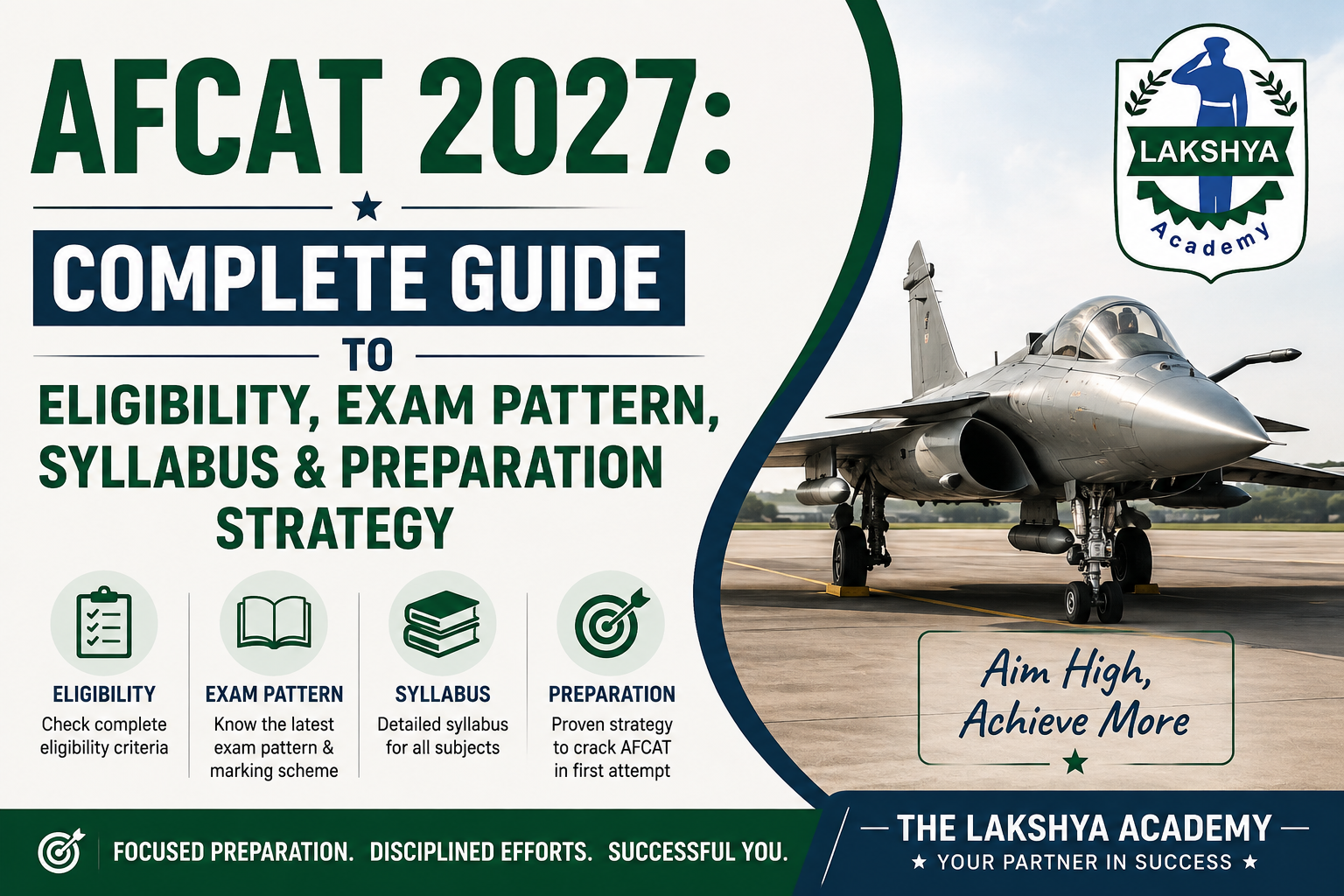
AFCAT 2027: Complete Guide If you dream of becoming an officer in the Indian Air Force, the Air Force Common Admission Test (AFCAT) is one of the most important opportunities available after graduation. AFCAT is conducted by the Indian Air Force for recruitment into the Flying Branch and Ground Duty (Technical and Non-Technical) branches.
With AFCAT 2027 approaching, this is the right time to understand the eligibility criteria, exam pattern, syllabus, selection process, and preparation strategy. This guide will help you build a structured preparation plan and avoid common mistakes.
What is AFCAT 2027: Complete Guide?
AFCAT stands for Air Force Common Admission Test. AFCAT 2027: Complete Guide provides eligible male and female candidates with an opportunity to join the Indian Air Force as officers.
As part of the AFCAT 2027: Complete Guide, it is important to know that the Indian Air Force ordinarily conducts AFCAT twice a year. The examination cycle is generally conducted around February and August, corresponding to the December and June application cycles.
Through AFCAT, candidates can apply for:
- Flying Branch
- Ground Duty (Technical)
- Ground Duty (Non-Technical)
The exact branches, vacancies, age limits and qualifications are specified in each official notification.
AFCAT 2027 Eligibility
Eligibility depends on the branch for which you are applying.
Flying Branch
As per the current IAF AFCAT eligibility criteria, candidates generally need to be 20 to 24 years of age as per the applicable rules. In the AFCAT 2027: Complete Guide, candidates should also note that those holding a valid Commercial Pilot Licence may receive the applicable age relaxation.
Educational qualification generally includes:
- Minimum 50% marks each in Mathematics and Physics at 10+2 level
- Graduation of at least three years with minimum 60% marks, or
- BE/B.Tech with minimum 60% marks
Ground Duty (Technical)
Candidates applying for Ground Duty Technical branches generally need to be 20 to 26 years of age and must possess the prescribed engineering or technology qualification. As part of the AFCAT 2027: Complete Guide, candidates should carefully check the applicable eligibility criteria before applying.
The required engineering disciplines depend on the particular technical branch mentioned in the notification.
Ground Duty (Non-Technical)
As covered in the AFCAT 2027: Complete Guide, Ground Duty Non-Technical branches include areas such as Administration, Logistics, Accounts, Education, Meteorology and Weapon Systems, subject to the qualifications specified in the official notification.
For several non-technical branches, candidates require graduation with a minimum of 60%, while specific branches such as Accounts have additional educational requirements.
Important: The AFCAT 2027: Complete Guide eligibility criteria should be checked against the official notification when it is released, as branch-wise requirements, vacancies and other conditions can change.
AFCAT 2027 Exam Pattern
The AFCAT written examination generally consists of 100 questions and is conducted for 2 hours.
The major sections are:
Subject Questions
General Awareness 25
Verbal Ability in English 25
Numerical Ability 25
Reasoning & Military Aptitude 25
Total 100
As part of the AFCAT 2027: Complete Guide, candidates should note that the current IAF examination information specifies 3 marks for every correct answer, 1 mark deducted for every incorrect answer, and no marks for an unattempted question.
Therefore, AFCAT preparation should focus not only on speed but also on accuracy.
AFCAT 2027 Syllabus
1. General Awareness
Focus on:
- Current Affairs
- Indian History
- Geography
- Indian Polity
- Economy
- Defence
- Sports
- Awards and Honours
- Important Days
- Science
- National and International Events
For General Awareness, regular revision is more important than trying to memorise everything in one sitting. This is an important part of the AFCAT 2027: Complete Guide and can help candidates improve their preparation and retention.
2. English
Important topics include:
- Reading Comprehension
- Error Detection
- Synonyms and Antonyms
- Idioms and Phrases
- Vocabulary
- Fill in the Blanks
- Sentence Completion
- Grammar
- One Word Substitution
As highlighted in the AFCAT 2027: Complete Guide, build your vocabulary gradually and practise questions regularly to strengthen your English preparation.
3. Numerical Ability
Important topics include:
- Percentage
- Profit and Loss
- Ratio and Proportion
- Average
- Time and Work
- Time, Speed and Distance
- Simple and Compound Interest
- Number System
- Mensuration
- Probability
- Data Interpretation
Focus on concepts first and calculation speed later.
4. Reasoning and Military Aptitude
Important areas include:
- Analogy
- Classification
- Series
- Coding-Decoding
- Blood Relations
- Venn Diagrams
- Logical Reasoning
- Non-Verbal Reasoning
- Spatial Ability
- Pattern Recognition
Regular practice can significantly improve your speed in this section.
AFCAT 2027 Preparation Strategy
Step 1: Understand the Complete Syllabus
Before starting preparation for the AFCAT 2027: Complete Guide, divide the syllabus into three categories:
Strong Topics → Average Topics → Weak Topics
Start working on your weak areas while continuously practising your strong areas.
Step 2: Build Strong Basics
As part of the AFCAT 2027: Complete Guide, do not immediately start solving difficult questions. First understand the concepts and learn the correct method of solving questions.
A strong foundation will help you solve unfamiliar questions during the examination.
Step 3: Make PYQs Your Priority
AFCAT Previous Year Questions (PYQs) are among the most useful resources for preparation.
While solving PYQs, analyse:
Frequently asked topics
Question difficulty
Time taken per question
Repeated concepts
Common mistakes
PYQs should not be treated simply as practice papers. They should be used to understand the examination.
Step 4: Practise Mock Tests
Once you have covered a reasonable portion of the syllabus, start attempting AFCAT mock tests.
After every mock test, analyse:
Attempted → Correct → Incorrect → Unattempted → Time Taken
Your score will improve when you learn from your mistakes rather than simply increasing the number of tests.
Step 5: Revise Regularly
Create short revision notes for:
Mathematics formulas
English vocabulary
Current Affairs
Static GK
Important facts
Frequently repeated concepts
Keep revising these notes instead of starting new material every day.
AFCAT Selection Process
Clearing the AFCAT written examination is only the first stage.
The selection process generally includes:
AFCAT Written Examination → AFSB → Medical Examination → All India Merit List
Candidates recommended by the Air Force Selection Boards proceed to medical examination. The final merit list is prepared based on performance in the written examination and AFSB interview, subject to medical fitness and available vacancies.
Therefore, candidates should not wait until the written result to start developing their communication skills, confidence, personality and officer-like qualities.
How to Prepare for AFSB Alongside AFCAT?
AFCAT and AFSB preparation should go hand in hand.
Along with academics, work on:
- Communication Skills
- General Awareness
- Confidence
- Group Discussion
- Psychological Tests
- Picture Perception and Discussion
- Interview Skills
- Leadership and Teamwork
The objective is not to create a fake personality but to develop the qualities required to perform naturally and confidently during the selection process.
Common Mistakes AFCAT Aspirants Should Avoid
- Starting preparation too late: Waiting for the notification can leave you with limited revision time.
- Ignoring English: English can become a scoring section with consistent practice.
- Avoiding Maths: Even if Maths is difficult initially, regular practice can improve accuracy and speed.
- Solving mocks without analysis: A mock test is useful only when you identify and correct your mistakes.
- Using too many resources: Choose limited, reliable study material and revise it repeatedly.
Final Tips for AFCAT 2027
AFCAT success requires a combination of conceptual clarity, PYQ practice, mock tests, revision and consistency.
Start early. Make a realistic timetable. Give equal attention to your weak and strong areas. Most importantly, keep analysing your performance.
Remember, the goal is not simply to clear AFCAT. The goal is to move one step closer to becoming an Indian Air Force officer.
Prepare for AFCAT 2027 with The Lakshya Academy
At The Lakshya Academy, AFCAT aspirants can prepare with a structured approach focused on the written examination as well as the officer-selection journey.
With the right guidance, regular practice, PYQs, mock tests and consistent revision, your AFCAT preparation can become more focused and result-oriented.
Start your AFCAT 2027 preparation today. Prepare smart, stay consistent and aim for the skies with The Lakshya Academy.