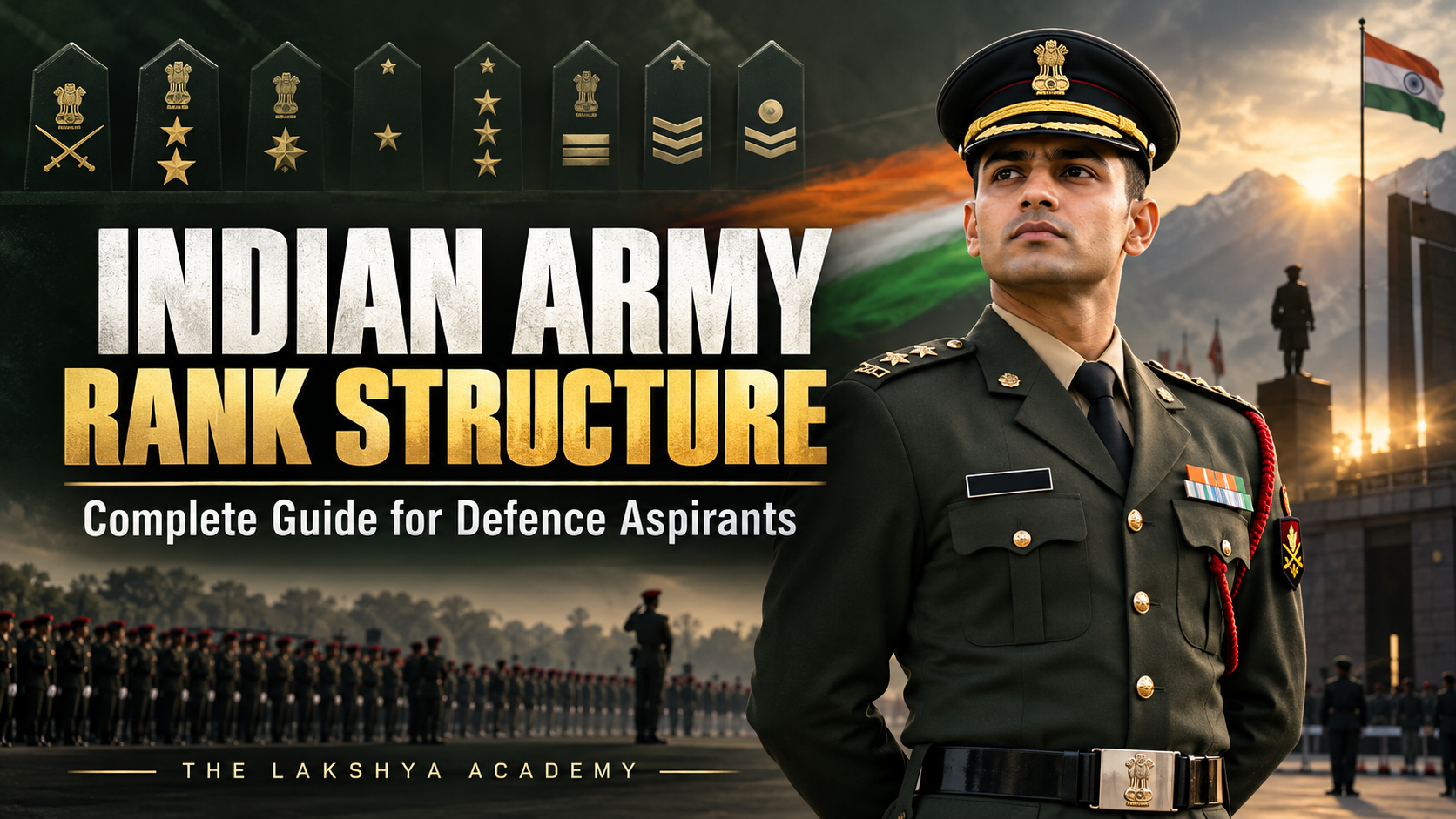
The Indian Army rank structure establishes a clear chain of command, defines responsibility and ensures discipline across every unit. For NDA, CDS, AFCAT and SSB aspirants, understanding the Indian Army rank structure is more than a general-knowledge topic—it helps them understand how leadership, authority and teamwork function within the armed forces.
This guide by The Lakshya Academy explains the Indian Army ranks in order, their broad responsibilities and why the rank system is essential.
What Is the Indian Army Rank Structure?
The Indian Army rank structure is the official hierarchy through which authority and responsibility flow within the Indian Army. Every soldier and officer holds a defined position in this system. The Indian Army rank structure enables orders to move efficiently from senior commanders to personnel at the operational level while ensuring accountability at every stage.
Indian Army personnel are broadly grouped into three categories:
Commissioned Officers
Junior Commissioned Officers (JCOs)
Other Ranks (OR)
Commissioned Officer Ranks in the Indian Army
Commissioned Officers play a key role in the Indian Army rank structure, leading troops, planning operations, managing resources and making important command decisions. Their ranks, from highest to lowest, are as follows.
1. Field Marshal
Field Marshal is the highest rank in the Indian Army rank structure. It is a five-star ceremonial rank awarded only in exceptional circumstances. The rank is held for life and represents the highest level of distinction within the Indian Army.
2. General
General is the highest active rank in the Indian Army rank structure. The Chief of the Army Staff holds this four-star rank and leads the Army at the national level. This rank represents the highest level of active military leadership within the Indian Army.
3. Lieutenant General
A Lieutenant General is a three-star officer in the Indian Army rank structure who may command an Army Command or hold other senior appointments at Army Headquarters and major formations. This rank carries significant leadership and operational responsibilities within the Indian Army.
4. Major General
A Major General is a two-star officer who generally commands a division or serves in an equivalent senior staff appointment.
5. Brigadier
A Brigadier is a one-star officer who generally commands a brigade comprising several battalions and supporting elements.
6. Colonel
A Colonel may command a battalion or hold an important staff appointment. The rank involves substantial responsibility for administration, training and operational readiness.
7. Lieutenant Colonel
A Lieutenant Colonel is an important rank in the Indian Army rank structure and commonly serves as a battalion commander or second-in-command, depending on the appointment and unit structure. The role involves significant leadership, operational planning and responsibility for personnel.
8. Major
A Major performs key company-level and staff duties. Officers at this rank contribute to planning, training, administration and operations.
9. Captain
A Captain may command a company or perform other operational and administrative appointments. Captains supervise troops and help execute unit-level plans.
10. Lieutenant
Lieutenant is the entry rank for a newly commissioned Indian Army officer. A Lieutenant generally leads a platoon and learns practical leadership under experienced commanders.
Junior Commissioned Officer Ranks
Junior Commissioned Officers form a vital link between Commissioned Officers and Other Ranks. Their experience, professional knowledge and close understanding of soldiers make them essential to unit cohesion.
1. Subedar Major
Subedar Major is the senior-most JCO rank. The Subedar Major acts as an important adviser to the commanding officer on matters involving troops, discipline, morale and welfare.
2. Subedar
A Subedar holds significant leadership and supervisory responsibilities within a unit and supports officers in training, administration and operations.
3. Naib Subedar
Naib Subedar is the entry rank in the JCO category. Personnel at this rank lead soldiers and assist in carrying out unit responsibilities.
Other Ranks in the Indian Army
Other Ranks are the operational backbone of the Army. They perform specialised, technical, combat and support duties across different arms and services.
1. Havildar
A Havildar is an experienced Non-Commissioned Officer who leads and supervises soldiers at the section level and supports junior leaders.
2. Naik
A Naik carries out junior leadership responsibilities and assists in leading a small group of soldiers.
3. Lance Naik
Lance Naik is the first level of junior leadership among Other Ranks and involves limited command and supervisory duties.
4. Sepoy
Sepoy is the entry-level soldier rank in many arms of the Indian Army. Equivalent designations may be used in certain regiments and corps according to their traditions.
Indian Army Ranks in Order
Category
Rank order from highest to lowest
Commissioned Officers
Field Marshal, General, Lieutenant General, Major General, Brigadier, Colonel, Lieutenant Colonel, Major, Captain, Lieutenant
Junior Commissioned Officers
Subedar Major, Subedar, Naib Subedar
Other Ranks
Havildar, Naik, Lance Naik, Sepoy
Why Is the Indian Army Rank Structure Important?
Clear Chain of Command
The hierarchy identifies who gives orders, who executes them and who is accountable. This clarity is crucial during training, administration and combat operations.
Discipline and Order
Military effectiveness depends on discipline. Clearly defined ranks help maintain professional conduct, respect for authority and organised functioning within every formation.
Defined Responsibility
Each rank carries specific command, operational and administrative duties. Personnel understand what is expected of them and to whom they report.
Faster Decision-Making
During demanding situations, uncertainty can be dangerous. A structured command system enables decisions and instructions to move quickly through appropriate channels.
Leadership Development
As personnel gain experience and earn promotions, they accept greater responsibility. The rank structure therefore creates a progressive path for developing leaders at every level.
Coordination Across Units
The Indian Army contains numerous arms, services and specialised formations. A common hierarchy allows them to coordinate effectively during joint training and operations.
Recognition of Experience and Service
Ranks reflect an individual’s level of responsibility, professional competence and experience. Promotion recognises growth while placing the individual in a role with greater accountability.
Why Defence Aspirants Should Learn Army Ranks
Knowledge of the Indian Army hierarchy is useful for written examinations, interviews, group discussions and SSB preparation. More importantly, it demonstrates genuine awareness of the organisation an aspirant wants to join.
Candidates should be able to:
Recall Indian Army ranks in the correct order.
Distinguish Commissioned Officers, JCOs and Other Ranks.
Understand the purpose of the chain of command.
Recognise the broad responsibilities associated with important ranks.
Avoid confusing Army ranks with those of the Navy and Air Force.
How to Remember the Rank Structure
Learn the ranks category-wise instead of memorising the entire list at once. Begin with Commissioned Officers, followed by JCOs and Other Ranks. Revise the sequence regularly, prepare a simple rank chart and practise comparison questions involving the Army, Navy and Air Force.
Conclusion
The Indian Army rank structure is the foundation of its command, discipline and leadership system. From a Lieutenant leading a platoon to a General directing the Army, every rank contributes to operational effectiveness. JCOs and Other Ranks further strengthen this system through experience, supervision and professional execution.
For aspirants preparing for NDA, CDS, AFCAT, SSB and other defence examinations, learning the Army ranks in order is an important step toward developing sound defence awareness.
The Lakshya Academy, Delhi provides structured preparation and expert guidance for defence aspirants committed to serving the nation.
Website: www.lakshyaacademy.co.in