Getting selected for the Indian Armed Forces is the dream of thousands of defence aspirants. However, clearing the written examination of NDA, CDS or AFCAT is only one part of the journey. The next and equally important step is the SSB Interview (Services Selection Board Interview).
The SSB Interview is a comprehensive personality assessment process designed to identify candidates who possess the qualities required to become officers in the Indian Army, Navy and Air Force. Unlike a normal job interview, it evaluates your intelligence, leadership, communication, decision-making, confidence, teamwork and overall personality.
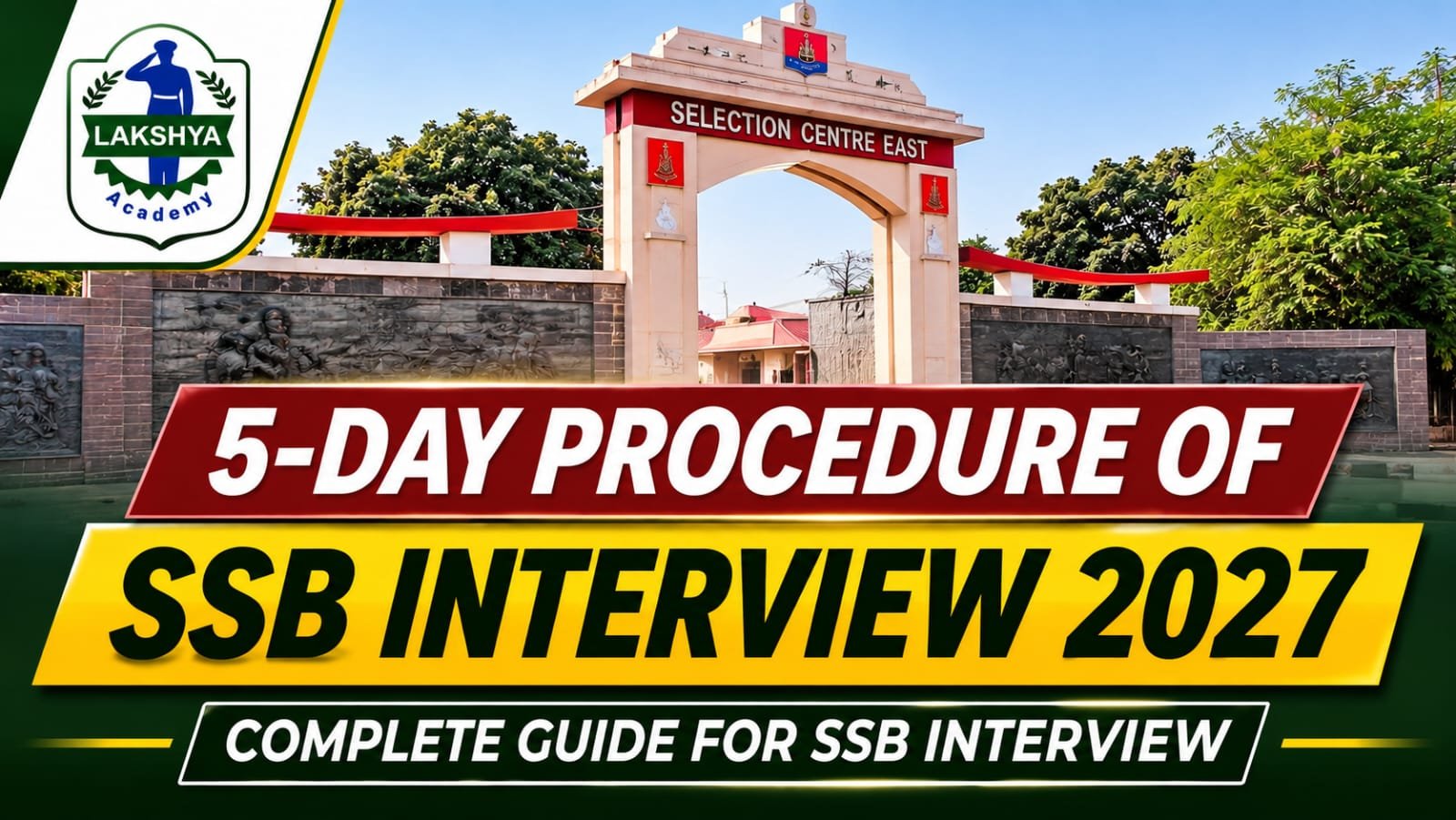
If you are preparing for NDA 2027, CDS 2027, AFCAT 2027 or other defence entries, understanding the 5 Days SSB Interview Procedure 2027 is essential.
In this complete guide by THE LAKSHYA ACADEMY, we will explain every stage of the SSB interview, the tests conducted each day, important preparation tips and how you can improve your chances of getting recommended.
What Is the SSB Interview?
The Services Selection Board (SSB) interview is a selection process conducted by the Indian Armed Forces to assess candidates for officer-level entries. It evaluates whether a candidate possesses the necessary Officer Like Qualities (OLQs) to become an effective military officer.
The SSB selection process involves three major assessors:
Psychologist: Evaluates your personality through psychological tests.
Group Testing Officer (GTO): Observes your behaviour, teamwork and leadership during group activities.
Interviewing Officer (IO): Assesses your personality, background, knowledge and decision-making through a personal interview.
The assessment is holistic. Candidates are evaluated through multiple activities rather than a single examination.
5 Days SSB Interview Procedure 2027 – Overview
The SSB selection procedure is divided into two stages:
Stage 1 – Screening Test: Officer Intelligence Rating (OIR) and Picture Perception and Discussion Test (PPDT).
Stage 2 – Psychological Tests, GTO Tasks, Personal Interview and Conference: Candidates who clear Stage 1 proceed to the remaining assessment, which is conducted over the next four days.
Here is the general day-wise schedule:
Reporting Day: Documentation and initial formalities.
Day 1: OIR Test and PPDT.
Day 2: Psychological Tests and Personal Interview (as scheduled).
Day 3: GTO Group Tasks and Personal Interview.
Day 4: Remaining GTO Tasks and Personal Interview.
Day 5: Conference and Final Result.
The exact sequence of Stage 2 activities may vary depending on the selection centre and batch.
Day 0: Reporting and Documentation
The first step of the SSB process is reporting at the designated selection centre according to the instructions mentioned in your call-up letter.
During the reporting process, candidates generally undergo:
Document verification.
Identity verification.
Initial briefing about the SSB procedure.
Allotment of chest numbers.
Filling out the Personal Information Questionnaire (PIQ).
Instructions regarding accommodation and the testing schedule.
Important Documents to Carry:
SSB call-up letter.
Original educational certificates and mark sheets.
Valid photo identity proof.
Passport-size photographs.
Other documents specifically mentioned in your call-up letter.
Always check the latest instructions issued by your respective selection centre before travelling.
Day 1: Screening Test – OIR and PPDT
Day 1 is one of the most important stages because candidates must clear the screening process to continue with the remaining four days.
The screening test consists of two major assessments.
1. Officer Intelligence Rating (OIR) Test
The OIR test evaluates your basic reasoning, intelligence and problem-solving ability.
It generally includes verbal and non-verbal reasoning questions such as:
Series completion.
Coding and decoding.
Analogy.
Classification.
Direction sense.
Mathematical reasoning.
Figure-based questions.
Preparation Tips:
Practise reasoning questions regularly, improve your calculation speed and develop accuracy under time pressure. Solving previous practice sets can help you become familiar with the question patterns.
2. Picture Perception and Discussion Test (PPDT)
PPDT evaluates your observation, imagination, communication and ability to participate in a group discussion.
The test generally consists of three steps:
Picture Observation: A hazy picture is displayed for a limited duration. Candidates observe the picture and identify the characters, their approximate age, mood and situation.
Story Writing: Candidates write a meaningful story based on their perception of the picture. The story should have a clear main character, a practical problem and a logical outcome.
Narration and Group Discussion: Candidates narrate their stories individually and participate in a group discussion to reach a common understanding.
How to Prepare for PPDT?
Improve your observation skills.
Practise writing short and realistic stories.
Speak clearly and confidently.
Listen to other candidates.
Participate actively without dominating the discussion.
Focus on logical solutions and teamwork.
Candidates who clear Stage 1 are shortlisted for Stage 2. Those who do not clear screening are generally sent back on the same day.
Day 2: Psychological Tests
Candidates who clear screening proceed to the psychological assessment conducted by the psychologist.
These tests are designed to understand your natural thought process, attitude, reactions and personality.
There are four major psychological tests:
1. Thematic Apperception Test (TAT)
In TAT, candidates are shown a series of pictures and asked to write stories based on them. A blank slide is also included.
The objective is to understand how candidates perceive situations, identify problems and develop practical solutions.
Preparation Tip: Practise developing realistic stories with a clear goal, positive initiative and logical outcomes.
2. Word Association Test (WAT)
In WAT, a series of words are displayed one after another for a short duration. Candidates must write sentences based on the words.
This test helps assess your spontaneous thought process and attitude.
Preparation Tip: Develop the habit of thinking positively and practically. Avoid memorised or artificial sentences.
3. Situation Reaction Test (SRT)
In SRT, candidates are presented with different real-life situations and must write how they would respond.
The test assesses decision-making, responsibility, problem-solving and the ability to handle challenging circumstances.
Preparation Tip: Practise responding to everyday situations with logical, responsible and practical solutions.
4. Self-Description Test (SDT)
In this test, candidates are asked to describe themselves from different perspectives, including:
What their parents think about them.
What their teachers think about them.
What their friends think about them.
What they think about themselves.
Their strengths and areas of improvement.
Preparation Tip: Understand yourself honestly. Your answers should reflect self-awareness rather than an artificially perfect personality.
Day 3: GTO Tasks – Group Testing Officer
The GTO series evaluates your ability to work in a team, communicate effectively, take initiative and demonstrate leadership.
Candidates participate in various indoor and outdoor group activities.
Important GTO tasks include:
1. Group Discussion (GD)
Candidates discuss given topics, often related to social issues, national matters or current affairs.
2.Group Planning Exercise (GPE)
Candidates are presented with a situation involving multiple problems and limited resources. They must develop a practical plan to solve the problems.
3. Progressive Group Task (PGT)
Candidates work together to cross a series of obstacles using supporting materials and following the given rules.
4. Half Group Task (HGT)
A similar group obstacle activity is conducted with a smaller group, allowing assessors to observe individual participation.
5. Group Obstacle Race
Also known as the Snake Race, candidates participate in a team obstacle race while carrying a specified load.
What Does the GTO Observe?
Cooperation and teamwork.
Leadership qualities.
Communication skills.
Practical intelligence.
Initiative and responsibility.
Ability to work under pressure.
Remember, the objective is not to dominate the group but to contribute effectively.
Day 4: Remaining GTO Tasks and Personal Interview
Day 4 generally includes the remaining GTO activities and personal interviews, depending on the schedule of the selection centre.
Important GTO activities include:
1. Individual Obstacles
Candidates complete a series of physical obstacles within the prescribed time.
These activities test courage, stamina, determination and confidence.
2. Command Task
Candidates are appointed as commanders and must complete an obstacle with the assistance of selected group members.
It evaluates leadership, planning, communication and decision-making.
3. Lecturette
Candidates are given topics and a limited preparation time to deliver a short speech before the group.
It evaluates communication, confidence, knowledge and the ability to organise thoughts.
4. Final Group Task (FGT)
The group works together to complete a final obstacle task. Teamwork and practical contribution remain important.
Personal Interview
The personal interview is conducted by the Interviewing Officer and may take place on Day 2, Day 3 or Day 4.
Common areas covered include:
Family background.
Educational qualifications.
Hobbies and interests.
Friends and social relationships.
Academic performance.
Sports and extracurricular activities.
Current affairs.
Strengths and weaknesses.
Motivation for joining the Armed Forces.
Life experiences and future goals.
Preparation Tips for the Personal Interview:
Be honest, confident and clear while answering questions. Know your own background, educational details and interests. Avoid memorising answers because the interviewer wants to understand your actual personality.
Day 5: Conference and Final Result
The fifth day is the final stage of the SSB interview.
During the conference, the Psychologist, GTO, Interviewing Officer and other board members discuss the candidate’s overall performance.
Candidates are called individually into the conference room, where they may be asked a few questions about their experience and stay at the selection centre.
After the conference, the final SSB recommendation result is announced.
What Happens After Getting Recommended?
Candidates who are recommended by the SSB proceed to the medical examination. Their medical fitness is assessed according to the prescribed standards of the respective service and entry.
It is important to understand that getting recommended by the SSB does not automatically guarantee final selection. Final selection also depends on medical fitness, merit position, vacancies and applicable eligibility requirements.
Important Officer Like Qualities (OLQs) Assessed in SSB
The SSB interview aims to identify 15 Officer Like Qualities (OLQs), broadly grouped into four factors:
Factor 1 – Planning and Organising Ability
Effective Intelligence.
Reasoning Ability.
Organising Ability.
Power of Expression.
Factor 2 – Social Adjustment
Social Adaptability.
Cooperation.
Sense of Responsibility.
Factor 3 – Social Effectiveness
Initiative.
Self-Confidence.
Speed of Decision.
Ability to Influence the Group.
Liveliness.
Factor 4 – Dynamic Qualities
Determination.
Courage.
Stamina.
Developing these qualities requires consistent effort, self-awareness and practical experience.
How to Prepare for SSB Interview 2027?
Success in SSB requires more than practising TAT, WAT, SRT or memorising interview questions. Candidates should work on their overall personality.
Here are some useful preparation tips:
Improve Communication Skills: Practise speaking clearly in English or Hindi and develop confidence in group discussions.
Stay Updated with Current Affairs: Read newspapers and follow national and international developments.
Develop Physical Fitness: Maintain stamina, strength and an active lifestyle.
Practise Psychological Tests: Understand the format of TAT, WAT, SRT and SDT.
Improve Self-Awareness: Understand your strengths, weaknesses, achievements and responsibilities.
Develop Teamwork: Participate in group activities and learn to cooperate with others.
Build Decision-Making Skills: Learn to analyse situations and take practical decisions.
Prepare for SSB Interview 2027 with THE LAKSHYA ACADEMY
Preparing for the SSB interview without proper guidance can be challenging, especially for first-time candidates. Understanding the testing procedure, practising regularly and receiving constructive feedback can make a significant difference.
THE LAKSHYA ACADEMY provides structured SSB preparation and personality development guidance to help defence aspirants understand the complete selection process.
Our SSB preparation focuses on:
Psychology tests: TAT, WAT, SRT and Self-Description.
GTO activities: GD, GPE, PGT, HGT, Command Task and other outdoor tasks.
Personal Interview preparation.
Lecturette and communication skills.
Current affairs and defence awareness.
Individual guidance and performance improvement.
With guidance from experienced defence professionals, candidates can understand the assessment process and work towards developing the qualities expected from future officers.
Remember: We train your mind, you take the decision.
Conclusion
The five-day SSB interview procedure is designed to assess your complete personality and potential to become an officer in the Indian Armed Forces. Every stage, from OIR and PPDT to psychological tests, GTO activities, personal interviews and the final conference, plays an important role in the selection process.
For NDA 2027, CDS 2027, AFCAT 2027 and other defence aspirants, the best approach is to start preparing early, understand the assessment system and work consistently on your Officer Like Qualities.
Your goal should not simply be to clear five days of testing. Your goal should be to develop the personality of a future officer.
Prepare with dedication. Stay confident. Take responsibility. And move one step closer to wearing the uniform.
THE LAKSHYA ACADEMY – Guiding Future Officers of the Indian Armed Forces.