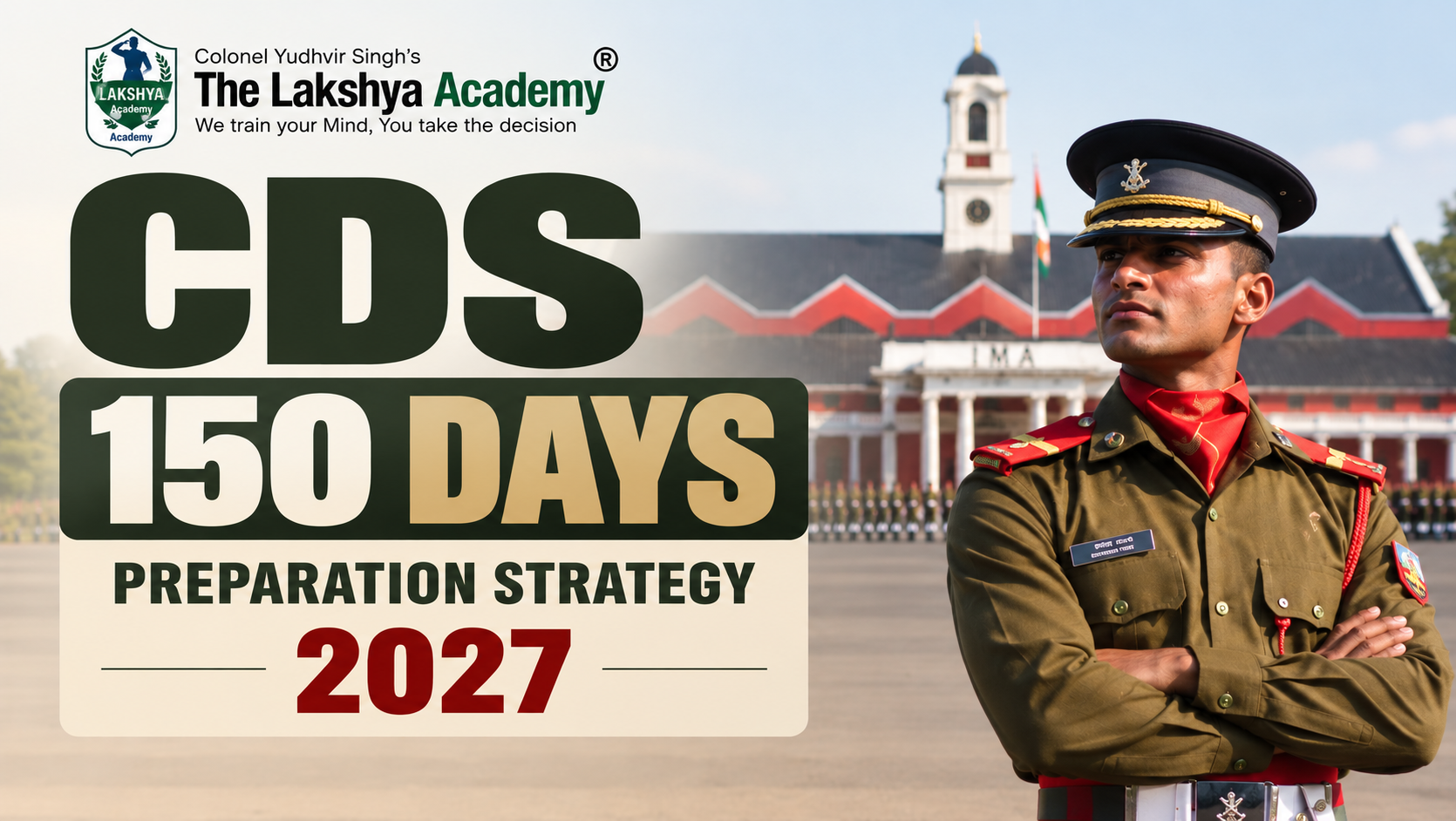
Preparing for the Combined Defence Services (CDS) examination requires a clear strategy, consistent practice, and effective time management. If you have 150 days to prepare for CDS 1 2027 or CDS 2 2027, this is the right time to build your fundamentals, practise previous year questions, and improve your performance through mock tests.
Many CDS aspirants struggle to decide what to study first, how to divide their time between subjects, and when to start revision. A well-planned CDS 150 days preparation strategy can help you organise your studies and prepare systematically for the UPSC CDS examination.
At The Lakshya Academy, we believe that successful defence exam preparation starts with the right direction, disciplined execution, and regular evaluation.
In this blog, you will learn how to prepare for the CDS exam in 150 days, create a daily study timetable, cover the syllabus, practise mock tests, and avoid common preparation mistakes.
What Is the CDS Examination?
The Combined Defence Services examination is conducted by the Union Public Service Commission (UPSC) to select eligible candidates for officer training at the Indian Military Academy (IMA), Indian Naval Academy (INA), Air Force Academy (AFA), and Officers’ Training Academy (OTA), subject to the applicable eligibility criteria.
The written examination tests candidates on different subjects depending on their chosen academy.
For IMA, INA, and AFA, the written examination includes:
- English
- General Knowledge
- Elementary Mathematics
For OTA, the written examination includes:
- English
- General Knowledge
Candidates should check the official UPSC notification for the relevant examination to confirm the exam pattern, eligibility requirements, and syllabus.
CDS 150 Days Preparation Strategy: Complete Roadmap
The key to preparing for CDS in 150 days is to divide your preparation into manageable phases. Instead of studying randomly, set clear targets for completing the syllabus, practising questions, revising important concepts, and taking mock tests.
Phase 1: Days 1–30 – Build Your Fundamentals
The first 30 days should focus on understanding the syllabus and strengthening your basic concepts.
English Preparation
English is an important subject in the CDS examination. Start by identifying your strengths and weaknesses in grammar, vocabulary, and comprehension.
Focus on:
- Parts of speech
- Tenses and subject-verb agreement
- Spotting errors
- Sentence improvement
- Synonyms and antonyms
- Idioms and phrases
- Reading comprehension
- Ordering of sentences
Practise English questions daily and maintain a notebook of unfamiliar words and recurring grammar mistakes.
General Knowledge Preparation
General Knowledge requires consistent study and regular revision. Begin with foundational topics and gradually expand your coverage.
Focus on:
- Indian history
- Indian geography
- Indian polity
- Basic economics
- General science
- Defence-related developments
- Important national and international current affairs
Use reliable study material and avoid collecting too many resources. Revise the topics you have already covered before moving to new material.
Elementary Mathematics Preparation
For IMA, INA, and AFA aspirants, build a strong foundation in mathematics.
Start with:
- Number systems
- HCF and LCM
- Percentages
- Ratio and proportion
- Profit and loss
- Time and work
- Time, speed, and distance
- Algebra
- Basic geometry
- Trigonometry
Begin with basic questions before progressing to exam-level problems. Candidates preparing for OTA can use this time to strengthen English and General Knowledge instead.
Target for the First 30 Days: Understand the syllabus, establish a daily routine, identify weak areas, and develop confidence in basic concepts.
Phase 2: Days 31–60 – Complete Important Topics and Practise Questions
After building your fundamentals, focus on covering the remaining syllabus and applying your knowledge to exam-style questions.
English: Practise mixed grammar exercises, vocabulary questions, comprehension passages, and previous year questions.
General Knowledge: Continue history, geography, polity, science, and economics. Revise factual information regularly and prepare concise notes for important topics.
Mathematics: Progress to more advanced questions in algebra, geometry, trigonometry, mensuration, statistics, and arithmetic.
Start solving topic-wise CDS previous year questions. These help you understand the nature of the questions, common concepts, and the level of difficulty.
At the end of each week, review your mistakes and revisit topics where your accuracy is low.
Target for Days 31–60: Cover a substantial portion of the syllabus and become comfortable solving questions within a time limit.
Phase 3: Days 61–90 – Previous Year Questions and Exam-Level Practice
The third phase should focus on strengthening your application of concepts.
Solving CDS previous year question papers is essential because it helps you understand the examination pattern and identify frequently tested concepts.
During this phase:
- Solve subject-wise previous year questions.
- Attempt timed practice sets.
- Revise difficult concepts.
- Maintain an error notebook.
- Improve question selection and time management.
- Revisit topics where you repeatedly make mistakes.
- For Mathematics, focus on calculation speed, accuracy, and choosing efficient methods.
- For English, practise a balanced mix of grammar, vocabulary, and comprehension questions.
- For General Knowledge, revise static topics regularly and continue following relevant current affairs.
Start attempting full-length mock tests under examination-like conditions. Analyse each test carefully instead of focusing only on your score.
Target for Days 61–90: Improve accuracy, recognise recurring question patterns, and identify the subjects that need additional attention.
Phase 4: Days 91–120 – Mock Tests and Intensive Revision
This phase is about improving your performance under time pressure.
Attempt full-length mock tests according to a consistent schedule. Increase the frequency gradually while leaving enough time to analyse each paper and revise weak topics.
After every mock test, ask yourself:
- Which questions did I answer incorrectly?
- Which topics consumed too much time?
- Did I make avoidable calculation mistakes?
- Did I attempt questions without sufficient confidence?
- Which concepts require further revision?
Do not judge your preparation solely by the number of questions attempted. Your accuracy, time management, and understanding of mistakes are equally important.
Revise your short notes frequently. Focus on formulas, grammar rules, important facts, and concepts that you tend to forget.
Target for Days 91–120: Develop a reliable exam strategy, reduce repeated mistakes, and improve performance in timed tests.
Phase 5: Days 121–150 – Final Revision and Exam Readiness
The final 30 days should focus on consolidation rather than trying to learn everything from scratch.
Revise important topics and formulas, solve selected previous year questions, and take mock tests at appropriate intervals.
For English, revise grammar rules, vocabulary, and common question types.
For General Knowledge, review your notes on history, geography, polity, science, economics, and relevant current affairs.
For Mathematics, revise formulas and practise questions from topics where you need improvement.
During the final week:
- Avoid starting too many new resources.
- Review your error notebook.
- Maintain a regular sleep schedule.
- Practise time management.
- Check your examination instructions and required documents.
- Keep your preparation routine calm and consistent.
Target for Days 121–150: Strengthen retention, maintain confidence, and enter the examination with a clear strategy.
Daily Study Timetable for CDS Preparation
A practical timetable helps you maintain consistency throughout the 150-day preparation period.
Candidates preparing for IMA, INA, or AFA can use the following example as a starting point. OTA candidates should redistribute the Mathematics time to English and General Knowledge.
Morning session
Spend 60 minutes revising concepts or practising Mathematics.
Second session
Dedicate 60 minutes to English grammar, vocabulary, and comprehension.
Afternoon or evening session
Spend 90 minutes studying General Knowledge and revising previously covered topics.
Practice session
Use 60 minutes for previous year questions, timed exercises, or mock-test analysis.
Final revision
Spend 30 minutes reviewing mistakes, formulas, vocabulary, and short notes.
This is an illustrative timetable, not a fixed requirement. Students with college or work commitments can adjust the duration while ensuring that all required subjects receive regular attention.
How to Prepare for CDS Mathematics in 150 Days
Mathematics can become a scoring opportunity when you understand the concepts and practise consistently.
Begin with arithmetic and number systems, then progress to algebra, geometry, trigonometry, mensuration, and statistics.
Follow these steps:
- Understand the concept before memorising formulas.
- Solve basic questions to build confidence.
- Practise CDS previous year questions topic by topic.
- Maintain a formula notebook.
- Attempt timed question sets.
- Analyse mistakes and repeat weak topics.
Do not spend too much time solving a single difficult question during practice. Learn to identify questions that you can solve accurately within the available time.
How to Prepare for CDS English in 150 Days
English preparation should include grammar, vocabulary, comprehension, and regular question practice.
Read quality English content to improve your understanding of sentence structure and usage. Learn new words in context and revise them regularly.
Practise questions on spotting errors, sentence improvement, synonyms, antonyms, idioms, and ordering of sentences.
Most importantly, solve previous year questions to understand how English concepts are tested in the CDS examination.
If English is your weak subject, begin with fundamental grammar rules and increase the difficulty gradually.
How to Prepare for CDS General Knowledge in 150 Days
General Knowledge requires a combination of conceptual understanding, factual learning, and revision.
Study static subjects systematically instead of switching between unrelated topics every day. Make short notes that are easy to revise.
Give particular attention to history, geography, polity, science, and economics. Follow reliable sources for current affairs and revise important developments regularly.
Previous year questions can help you identify areas that deserve more attention, but do not assume that a topic will appear simply because it appeared in earlier papers.
Use mock tests to identify gaps in your knowledge and improve your ability to recall information.
Importance of CDS Previous Year Question Papers
Previous year question papers are an important part of a successful CDS preparation strategy.
They help you understand the format of questions, test your knowledge, and evaluate your preparation against the examination standard.
Solve them in three ways:
- Topic-wise practice: Strengthen individual concepts.
- Timed subject practice: Improve speed and accuracy.
- Full-length papers: Develop exam temperament and time management.
After completing each paper, analyse your incorrect answers and revise the relevant concepts.
Avoid memorising answers without understanding why they are correct. Conceptual clarity helps you handle variations of familiar questions.
Common Mistakes to Avoid During CDS Preparation
Even a 150-day study plan can become ineffective if you do not follow it consistently.
Avoid these common mistakes:
Studying without a plan: Set daily and weekly targets instead of deciding what to study at the last minute.
Ignoring revision: Revisiting concepts helps strengthen retention and reduces repeated mistakes.
Using too many resources: Select a manageable set of reliable books, notes, and practice materials.
Avoiding mock tests: Timed tests help reveal weaknesses that ordinary study sessions may not expose.
Focusing only on attempted questions: Accuracy and question selection matter alongside speed.
Neglecting weak subjects: Give additional time to difficult topics while maintaining your strengths.
Ignoring the official syllabus: Use the relevant UPSC notification to guide your preparation and avoid unnecessary topics.
What Should You Do After Clearing the CDS Written Examination?
Your preparation does not end with the written examination. Candidates who qualify should follow the official instructions for the next stage and prepare for the SSB interview.
SSB preparation involves screening tests, psychological assessments, GTO tasks, the personal interview, and the conference, according to the prescribed selection process.
Begin working on communication, self-awareness, reasoning, teamwork, and general awareness early. Keep the required documents ready and follow the applicable call-up instructions.
The CDS written examination and SSB interview assess different aspects of a candidate’s suitability. Therefore, written exam preparation and personality development should be approached as complementary parts of the selection journey.
Why Choose The Lakshya Academy for CDS Preparation?
Choosing the right guidance can help aspirants organise their preparation and work towards their goals with greater clarity.
The Lakshya Academy provides preparation support for defence examinations, including NDA, CDS, AFCAT, and SSB interview preparation.
A structured preparation approach can help candidates focus on:
- Subject-wise syllabus coverage
- Concept building and practice
- Previous year question solving
- Mock tests and performance analysis
- Revision and time management
- SSB interview preparation
The academy’s objective is to help defence aspirants develop disciplined study habits and prepare systematically for their examinations.
To learn more about courses and preparation programmes, visit the official website: www.lakshyaacademy.co.in
For course-related queries, contact the student coordinator at 7827363838.
Final Words: Your CDS Preparation Starts Today
Preparing for CDS in 150 days is an achievable planning goal, but success depends on your current preparation level, consistency, subject knowledge, and execution of the study plan.
Build strong fundamentals during the first month, complete important topics, practise previous year questions, take mock tests, and revise systematically during the final weeks.
Remember that a study plan works only when you follow it with discipline and evaluate your progress honestly.
Set your target, trust your preparation, and work towards your goal every day.
We train your mind, you take the decision.