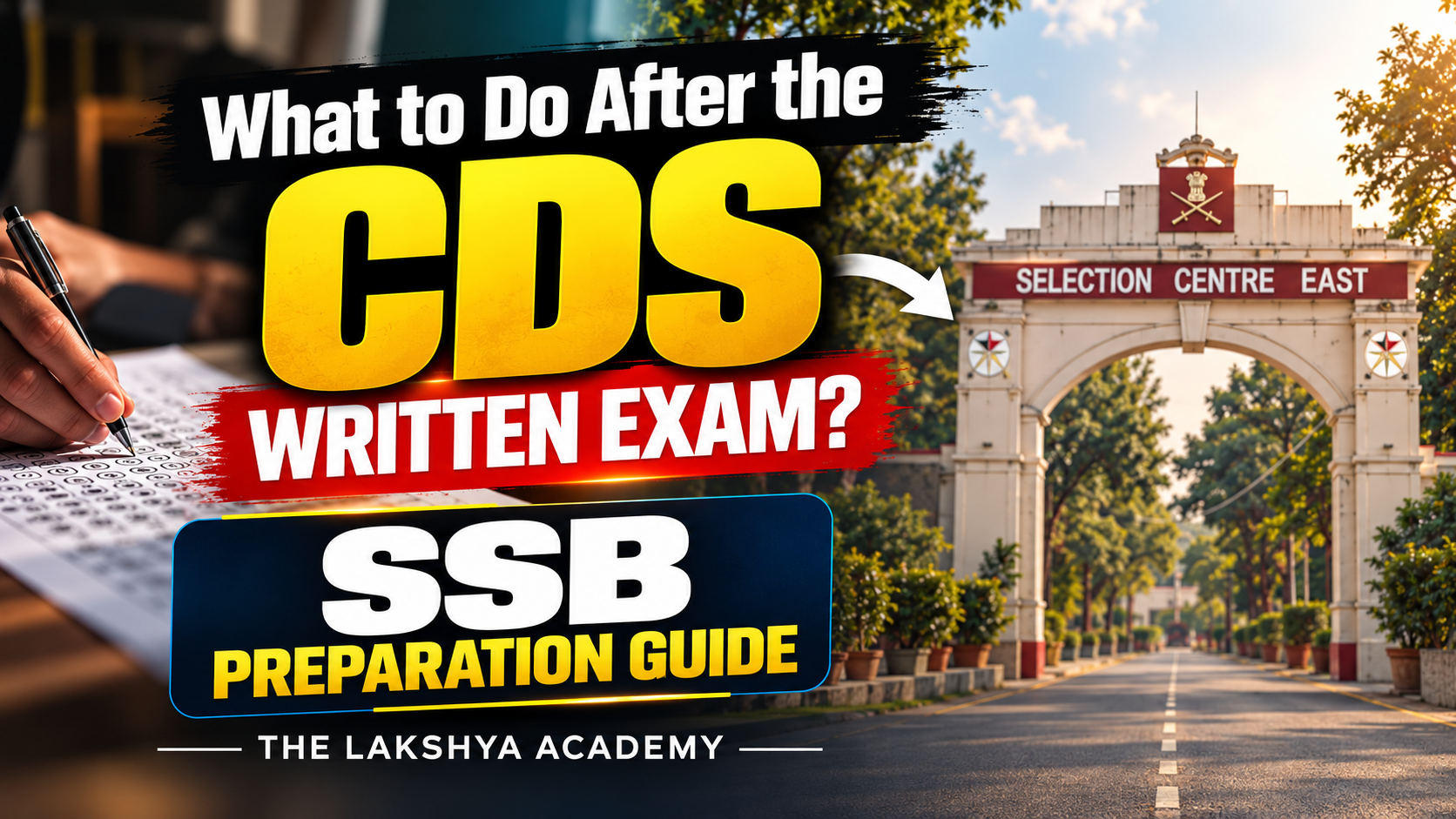
Clearing the Combined Defence Services (CDS) written examination is an important milestone for candidates who aspire to become officers in the Indian Armed Forces. However, the written examination is only one part of the selection process. Candidates who qualify must prepare for the Services Selection Board (SSB) assessment and subsequent stages of selection.
If you have appeared for CDS 1 or CDS 2 and are wondering what to do after the CDS written exam, this guide will help you understand the next steps, the SSB interview process, and how to prepare effectively.
At The Lakshya Academy, we guide defence aspirants in developing the confidence, personality, communication skills, and practical abilities required for SSB preparation.
What Happens After the CDS Written Exam?
After the CDS written examination, candidates should focus on the following steps:
Check the official CDS written examination result.
Verify the next-stage instructions and eligibility requirements.
Complete the required registration or application formalities, wherever applicable.
Keep documents ready for SSB call-up and verification.
Begin structured SSB interview preparation without waiting until the last moment.
Follow official instructions regarding reporting dates and selection procedures.
Candidates should regularly check the official UPSC website and the relevant service recruitment website for result announcements, registration requirements, and SSB call-up information.
Remember, qualifying for the written examination does not guarantee final selection. Candidates must successfully complete the remaining selection stages and meet the applicable eligibility and medical requirements.
Understand the CDS SSB Interview Process
The CDS SSB interview is designed to assess a candidate’s suitability for a career as an officer in the Armed Forces. It evaluates personality, reasoning ability, communication, decision-making, teamwork, and leadership potential.
The SSB selection process generally consists of two stages.
Stage 1: Screening Test
The first stage determines whether candidates qualify for further assessment.
1. Officer Intelligence Rating (OIR) Test
The OIR test assesses reasoning and problem-solving abilities through verbal and non-verbal intelligence questions. Candidates should practise questions involving patterns, series, analogies, classification, and logical reasoning.
2. Picture Perception and Discussion Test (PPDT)
In PPDT, candidates observe a picture, write a story based on their perception, and participate in a group discussion.
To prepare effectively:
Practise observing pictures within the given time.
Develop clear and realistic stories.
Identify the main character and the situation.
Focus on practical actions and logical outcomes.
Practise speaking confidently during group discussions.
Listen to other candidates and communicate respectfully.
Candidates who qualify the screening stage proceed to Stage 2. Those who do not qualify are generally sent back according to the prescribed procedure.
Stage 2: Psychological Tests, GTO Tasks and Interview
Candidates who clear screening undergo further assessment over the prescribed schedule.
1. Psychological Tests
These tests assess behavioural responses, thought processes, and personality characteristics. Common exercises include:
Thematic Apperception Test (TAT)
Word Association Test (WAT)
Situation Reaction Test (SRT)
Self-Description Test (SD)
Candidates should practise structured responses while remaining natural and honest. The objective is not to memorise model answers but to develop self-awareness, practical thinking, and consistency.
2. Group Testing Officer (GTO) Tasks
GTO tasks assess group behaviour, cooperation, planning, communication, and leadership potential.
Preparation may include:
Group Discussion (GD)
Group Planning Exercise (GPE)
Progressive Group Task (PGT)
Half Group Task (HGT)
Individual Obstacles
Command Task
Lecturette
Other activities included in the prescribed assessment schedule
Candidates should work on clear communication, teamwork, initiative, and the ability to contribute constructively to a group.
3. Personal Interview
The personal interview helps assess a candidate’s background, interests, responsibilities, motivation, and suitability for military service.
Prepare to discuss your education, family, hobbies, achievements, strengths, areas for improvement, and reasons for joining the Armed Forces.
Be honest and specific. Avoid memorised answers that do not reflect your actual experiences.
4. Conference
At the conference, assessors review the candidate’s performance across the assessment process and decide the recommendation outcome according to the applicable procedure.
How to Start CDS SSB Preparation After the Written Exam
The best time to start SSB preparation is as early as possible. Do not wait for the written result or SSB call letter to begin developing the required skills.
1. Improve Your Communication Skills
Clear communication is useful during PPDT, group discussions, lecturettes, and the personal interview.
Read reliable newspapers, discuss current affairs, and practise expressing your opinions in simple, structured English. Focus on clarity rather than using complicated vocabulary.
2. Practise OIR and PPDT Regularly
Solve reasoning questions under timed conditions. For PPDT, practise picture observation, story writing, narration, and group discussion.
Review your performance to identify areas that need improvement.
3. Develop Self-Awareness
Prepare a realistic understanding of your strengths, weaknesses, habits, interests, and responsibilities.
Reflect on your academic performance, relationships, achievements, and setbacks. Self-awareness will help you answer interview questions naturally and consistently.
4. Build General Awareness
Stay informed about national and international developments, defence-related news, Indian Armed Forces, and important current affairs.
Develop an understanding of major issues rather than simply memorising headlines. Practise explaining a topic in your own words.
5. Maintain Physical Fitness
Regular physical activity can help you build stamina, discipline, and confidence during physically demanding activities.
Include running, mobility exercises, strength training, and other suitable activities in your routine. Increase intensity gradually and follow safe exercise practices.
6. Practise Psychological Tests Under Time Limits
Familiarise yourself with TAT, WAT, SRT, and SD exercises. Practise responding within the prescribed time while keeping your answers realistic and consistent with your personality.
Avoid copying answers from online sources or trying to present an artificial personality.
7. Prepare for the Personal Interview
Review your application details, academic background, achievements, hobbies, and experiences. Be prepared to explain why you want to join the Armed Forces and what you understand about military life.
The goal is to communicate honestly and demonstrate maturity, responsibility, and motivation.
CDS SSB Preparation: A Simple Daily Routine
A balanced daily routine can help candidates prepare systematically.
Morning: Exercise, running, or another suitable fitness activity.
Study session: Practise OIR questions and review mistakes.
Communication practice: Read current affairs and practise speaking on a topic.
Psychology practice: Work on selected TAT, WAT, or SRT exercises.
Evening: Review defence-related news, reflect on the day’s progress, and prepare for the next day.
Weekly practice: Conduct a mock interview, practise PPDT narration, and participate in group discussions whenever possible.
The schedule should be adapted to your current abilities, available time, and SSB reporting date.
Documents to Prepare Before the SSB Interview
Candidates should carefully read their official call-up instructions and arrange the documents specified for their entry.
Depending on the applicable requirements, these may include:
SSB call-up letter and reporting instructions
Valid photo identification
Matriculation certificate or other prescribed proof of date of birth
Educational certificates and mark sheets
Graduation documents or other qualification-related records
Required photographs and additional forms
Any other documents specifically requested by the relevant authority
Document requirements can vary according to the entry and candidate’s circumstances. Follow the instructions in the official call-up letter rather than relying only on a general checklist.
What Happens After the SSB Interview?
Candidates recommended by the SSB must complete the remaining selection formalities.
These generally include the prescribed medical examination and subsequent merit-list and joining procedures. Final selection depends on the applicable eligibility conditions, medical fitness, merit position, vacancies, and official selection rules.
SSB recommendation alone does not guarantee final appointment.
Candidates should continue monitoring official recruitment updates and maintain their preparation until the selection process is complete.
Common Mistakes to Avoid During CDS SSB Preparation
Many candidates focus only on written examination preparation and start SSB practice too late. Others memorise stories, copy interview answers, or try to dominate group discussions.
Avoid these common mistakes:
Waiting for the SSB call letter before starting preparation.
Memorising psychological test answers.
Speaking excessively during group discussions.
Ignoring physical fitness and general awareness.
Giving exaggerated or dishonest answers in interviews.
Neglecting official documents and reporting instructions.
Treating SSB as a test of speaking English alone.
A balanced approach that develops reasoning, communication, self-awareness, teamwork, and practical decision-making is more useful than practising isolated answers.
Why Choose The Lakshya Academy for CDS SSB Preparation?
Preparing for the CDS SSB interview requires a structured approach to the different assessment activities. Guidance and regular practice can help candidates understand the process, recognise their weaknesses, and improve their performance.
The Lakshya Academy supports defence aspirants preparing for NDA, CDS, AFCAT, and SSB through focused preparation and practice.
Candidates can work on areas such as:
OIR and PPDT practice
Psychological test preparation
Group discussion and GTO task practice
Personal interview preparation
Communication and personality development
Current affairs and defence awareness
The aim is to help candidates understand the SSB process and prepare with greater confidence, consistency, and self-awareness.
To learn more about available courses and SSB preparation programmes, visit the official website: www.lakshyaacademy.co.in
For course-related queries, contact the student coordinator at 7827363838.
Final Words
The CDS written examination is an important step towards a career in the Indian Armed Forces, but your preparation should not stop there. Understanding the SSB selection process and beginning systematic preparation early can help you approach the next stage with greater confidence.
Work on your communication, reasoning, physical fitness, self-awareness, and teamwork. Practise regularly, stay updated with official instructions, and focus on becoming a better version of yourself rather than memorising ideal answers.
Your Lakshya, Our Mission.
The Lakshya Academy – We train your mind, you take the decision.