English is an important subject for students preparing for competitive defence examinations such as NDA, CDS and AFCAT. A strong command of English can help aspirants improve their written examination performance, understand questions accurately and develop communication skills required during the selection process.
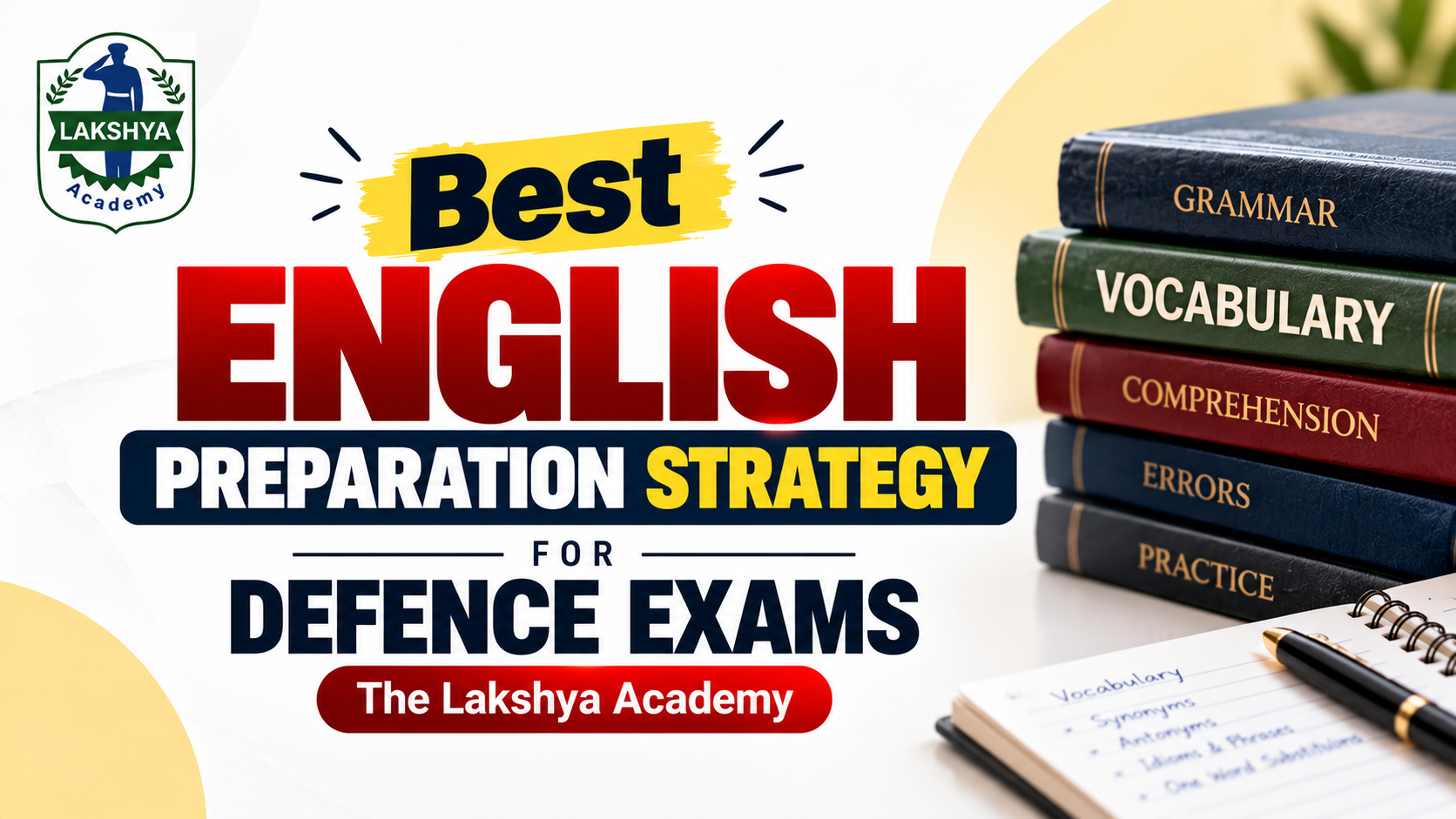
Many defence aspirants struggle with English grammar, vocabulary, reading comprehension and sentence formation. However, by following the Best English Preparation Strategy for Defence Exams, practising regularly and getting proper guidance, students can gradually improve their English proficiency and perform better in defence examinations.
The Lakshya Academy provides defence examination preparation guidance for aspirants aiming to join the Indian Armed Forces through NDA, CDS, AFCAT and other officer-entry routes.
In this blog, we will discuss the best English preparation strategy for defence exams, important topics, daily study routines and practical tips to improve accuracy and confidence.
Why Is English Important for Defence Exams ?| Best English Preparation Strategy for Defence Exams
English plays an important role in several defence entrance examinations. Following the Best English Preparation Strategy for Defence Exams can help students improve their grammar, vocabulary, comprehension skills and overall performance, although the exam pattern and weightage vary by examination.
NDA: English is part of the General Ability Test (GAT).
CDS: English is a separate written examination paper.
AFCAT: Verbal Ability in English is included in the online examination.
Preparing English systematically with the Best English Preparation Strategy for Defence Exams helps candidates improve grammar, vocabulary, comprehension and overall language proficiency.
English is also useful beyond the written examination. Clear communication and the ability to express ideas effectively can support candidates during interviews, group discussions and other selection activities.
1. Understand the English Syllabus for NDA, CDS and AFCAT
Before beginning your preparation, understand the syllabus and question patterns of your target examination. Following the Best English Preparation Strategy for Defence Exams will help you prioritise important topics and avoid wasting time on irrelevant study material.
NDA English Preparation
For NDA aspirants, the Best English Preparation Strategy for Defence Exams should focus on grammar, vocabulary, comprehension and the correct usage of English, as English is included in the General Ability Test (GAT) paper.
Important topics include:
Spotting Errors
Synonyms and Antonyms
Selecting Words
Sentence Improvement
Idioms and Phrases
Reading Comprehension
Ordering of Words and Sentences
Fill in the Blanks
Grammar and Usage
CDS English Preparation
As part of the Best English Preparation Strategy for Defence Exams, understand the syllabus and question patterns of your target examination before beginning preparation. This will help you prioritise important topics and avoid wasting time on irrelevant study material.
Important topics include:
Parts of Speech
Tenses and Subject-Verb Agreement
Articles and Prepositions
Synonyms and Antonyms
Ordering of Sentences
Sentence Improvement
Spotting Errors
Reading Comprehension
Idioms and Phrases
Word Usage
AFCAT English Preparation
AFCAT includes Verbal Ability in English. Following the Best English Preparation Strategy for Defence Exams helps aspirants focus on vocabulary, grammar, comprehension and examination-oriented practice to improve their performance.
Important topics include:
Comprehension
Error Detection
Sentence Completion
Synonyms and Antonyms
Idioms and Phrases
One-Word Substitution
Cloze Test
Sentence Rearrangement
Basic Grammar and Vocabulary
Always check the latest official notification and syllabus for your target examination.
2. Build a Strong Foundation in English Grammar
Grammar is an essential part of the Best English Preparation Strategy for Defence Exams. Understanding grammatical rules helps candidates solve error-detection, sentence-improvement and fill-in-the-blank questions more accurately.
Start with the fundamentals before moving to advanced questions.
Focus on these topics:
Parts of Speech
Tenses
Subject-Verb Agreement
Articles
Prepositions
Conjunctions
Active and Passive Voice
Direct and Indirect Speech
Modals
Conditional Sentences
Sentence Structure
Preparation tip: Study one grammar topic at a time. Understand the rules, solve practice questions and note the mistakes you repeatedly make.
As part of the Best English Preparation Strategy for Defence Exams, practise subject-verb agreement questions after learning the rules. Focus on singular and plural subjects, collective nouns and commonly confused sentence structures to improve your accuracy in the exam.
Consistent practice is more effective than memorising grammar rules without applying them.
3. Improve Vocabulary for NDA, CDS and AFCAT
Vocabulary is essential for answering questions involving synonyms, antonyms, idioms, phrases and word meanings.
Many students try to memorise hundreds of words in a single day but struggle to remember them later. The Best English Preparation Strategy for Defence Exams is to learn a manageable number of words daily and revise them regularly to improve vocabulary and long-term retention.
Follow these steps:
Learn 10–15 new words daily. Write down each word, its meaning, synonyms, antonyms and an example sentence.
Maintain a vocabulary notebook. Organise unfamiliar words in one place for quick revision.
Revise previously learned words. Review old words regularly instead of focusing only on new vocabulary.
Practise previous-year questions. This helps you become familiar with the vocabulary used in defence examinations.
Learn idioms and phrases. Understand their meanings and practise using them in context.
For example, learning a word along with its meaning and usage in a sentence can make it easier to remember than simply memorising a definition.
4. Develop a Daily English Reading Habit
Reading regularly helps improve vocabulary, comprehension and familiarity with correct sentence structures.
As part of the Best English Preparation Strategy for Defence Exams, aspirants should develop a daily reading habit by reading English newspapers, editorials, short articles and other reliable English-language material to improve vocabulary, comprehension and overall language skills.
As part of the Best English Preparation Strategy for Defence Exams, start with simple reading passages if you find advanced English difficult. Gradually move on to more challenging material as your comprehension and vocabulary improve.
During reading practice:
Identify unfamiliar words.
Understand the central idea of each paragraph.
Summarise the passage in your own words.
Observe how sentences are constructed.
Practise answering questions based on the passage.
The Best English Preparation Strategy for Defence Exams includes regular reading comprehension practice. Candidates must understand the context, identify key information and interpret the author’s message rather than simply memorising individual word meanings.
Practise short passages daily and gradually increase their difficulty.
5. Practise Previous-Year Questions for Defence Exams
Previous-year question papers are an important resource for NDA, CDS and AFCAT English preparation.
They help aspirants understand the examination pattern, practise relevant question types and identify areas that need improvement.
Solve previous-year English questions after completing the basic concepts of each topic.
While practising, focus on:
Accuracy
Time management
Understanding question patterns
Identifying repeated mistakes
Applying grammar rules correctly
Do not simply check how many questions you answered correctly. Review every incorrect answer and understand why your chosen option was wrong.
This process helps turn mistakes into learning opportunities.
6. Take Regular English Mock Tests
The Best English Preparation Strategy for Defence Exams includes regular mock tests to help candidates evaluate their preparation, improve time management and build confidence under timed examination conditions.
Start with topic-wise tests as part of the Best English Preparation Strategy for Defence Exams, then gradually progress to sectional tests and full-length mock examinations to improve accuracy, speed and exam readiness.
After every mock test, analyse your performance.
Ask yourself:
Which grammar topics caused the most mistakes?
Which vocabulary questions were difficult?
Did I spend too much time on one question?
Were my mistakes caused by poor understanding or careless reading?
Which topics should I revise before the next test?
Maintain a record of your performance so that you can track improvement over time.
Remember that the Best English Preparation Strategy for Defence Exams involves more than just scoring well in mock tests. Candidates should use test results to identify weaknesses, analyse mistakes and improve their preparation strategy for better performance.
7. Best Daily Study Routine for English Preparation
Following the Best English Preparation Strategy for Defence Exams with a consistent daily routine can help aspirants improve their English skills while giving adequate attention to other subjects required for defence examinations.
A sample 60-minute English study session is given below.
First 15 minutes – Grammar
Revise one grammar concept and solve related practice questions.
Next 15 minutes – Vocabulary
Learn new words, practise synonyms and antonyms, and revise previously studied vocabulary.
Next 15 minutes – Reading Comprehension
Read a passage and answer questions based on its main idea, details and context.
Last 15 minutes – Exam Practice
Solve previous-year questions or a short English practice test. Review your incorrect answers.
Adjust this routine according to your current proficiency, target examination and preparation schedule.
8. How Hindi-Medium Students Can Improve English
Students from Hindi-medium backgrounds can also build strong English skills through systematic preparation and regular practice.
If you find English difficult, begin with simple sentences and basic grammar concepts. Understand the meaning of sentences before attempting advanced examination questions.
Here are some practical suggestions:
Learn basic English grammar step by step.
Read short English passages every day.
Learn useful words and phrases in context.
Practise making simple English sentences.
Listen to clear English conversations.
Speak in English regularly without worrying about every mistake.
Revise your vocabulary and grammar notes.
Gradually increase the difficulty of your practice questions.
Avoid comparing your progress with students who already have a strong English background. Focus on improving your own accuracy, understanding and confidence.
The goal is not to learn everything in a few days. The goal is to improve consistently.
9. Common Mistakes to Avoid During English Preparation
Many aspirants spend considerable time studying English but do not see the expected improvement because their preparation lacks direction.
Avoid these common mistakes:
Memorising grammar without practice: Apply every rule through relevant questions.
Learning words without revision: Revisit vocabulary regularly to improve retention.
Ignoring reading comprehension: Reading practice improves both comprehension and contextual vocabulary.
Using too many study resources: Choose reliable resources and complete them systematically.
Avoiding mock tests: Regular testing helps reveal weaknesses before the actual examination.
Ignoring incorrect answers: Understanding why an answer is wrong is an essential part of learning.
Preparing without a timetable: Divide your study time between grammar, vocabulary, reading and question practice.
A structured approach helps you use your preparation time more effectively.
10. How The Lakshya Academy Can Help Defence Aspirants
The Lakshya Academy focuses on preparation for defence examinations, including NDA, CDS, AFCAT and SSB.
Aspirants should look for preparation guidance that helps them understand fundamental concepts, practise examination-oriented questions and improve their overall readiness.
For English preparation, students should prioritise grammar fundamentals, vocabulary development, reading comprehension, previous-year questions and regular performance analysis.
Candidates should also remember that written examination preparation and SSB interview preparation are different stages. Along with academic preparation, aspirants should work on communication, teamwork, confidence and responsible decision-making.
To learn more about defence examination preparation, visit the official website of The Lakshya Academy.
Website: https://www.lakshyaacademy.co.in/
Contact: 7827363838
Conclusion
The best English preparation strategy for NDA, CDS and AFCAT is based on strong grammar, regular vocabulary revision, daily reading and consistent question practice.
Start with the basics, follow a realistic timetable and solve previous-year questions regularly. Use mock tests to identify weaknesses and revise the concepts that need more attention.
Whether you are preparing for NDA after school or targeting CDS and AFCAT after graduation, consistent effort can help you develop better English skills and approach the examination with greater confidence.
The Lakshya Academy – We train your mind, you take the decision.