Joining the Indian Armed Forces as an officer is a dream for thousands of students across India. Candidates preparing for NDA, CDS, and AFCAT need more than academic knowledge to achieve this goal. They must understand the complete selection process, prepare strategically for the written examination, develop officer-like qualities, and perform confidently during the Services Selection Board (SSB) interview.
At The Lakshya Academy, we help defence aspirants understand the selection process and prepare for different stages of their journey towards becoming commissioned officers in the Indian Armed Forces.
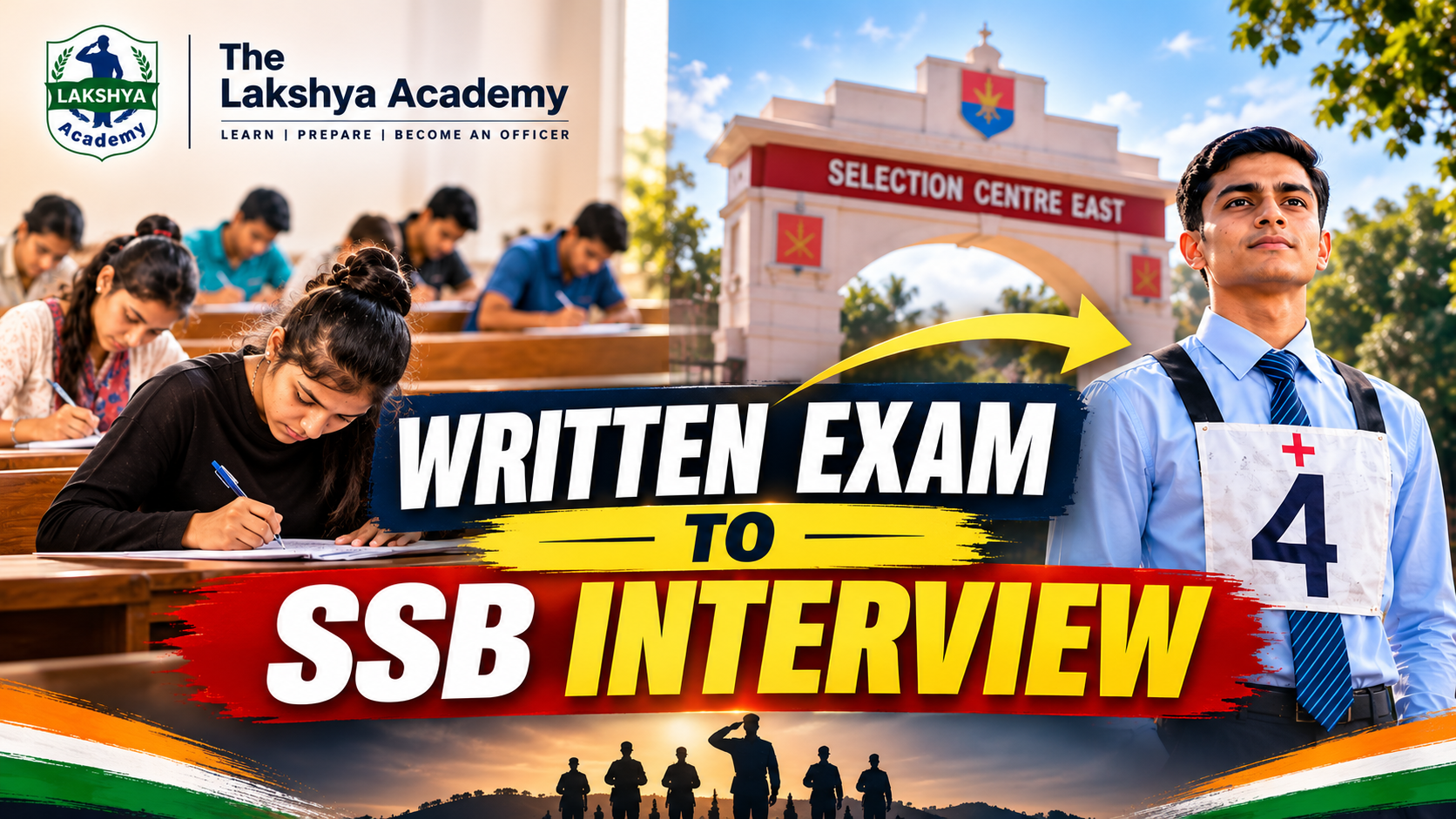
This guide explains the complete defence selection roadmap, from written exam preparation to SSB interview and medical examination.
Understanding the Defence Selection Process
The selection process depends on the entry scheme and the candidate’s eligibility. NDA, CDS, and AFCAT follow different examination and selection procedures, but candidates generally need to clear the relevant written examination or initial selection stage before proceeding to the SSB or AFSB assessment.
The major stages include:
Understanding eligibility criteria
Preparing for the written examination
Qualifying the written examination
Preparing for SSB or AFSB assessment
Clearing Stage I screening
Qualifying Stage II testing
Completing the required medical examination
Securing merit-based selection and joining instructions
Candidates should always check the latest official notification for their particular entry because selection procedures and requirements may differ.
Step 1: Choose the Right Defence Entry
Before starting preparation, candidates should identify the entry that matches their age, educational qualification, and career goals.
NDA Examination
The National Defence Academy (NDA) examination is conducted by UPSC for eligible candidates seeking entry into the Army, Navy, and Air Force through the NDA and Naval Academy routes, as applicable.
Students generally begin preparing for NDA while studying in Class 11 or 12. The written examination includes Mathematics and the General Ability Test (GAT).
CDS Examination
The Combined Defence Services (CDS) examination is conducted by UPSC for eligible graduates seeking entry into academies such as the Indian Military Academy (IMA), Indian Naval Academy (INA), Air Force Academy (AFA), and Officers’ Training Academy (OTA), subject to the relevant eligibility criteria.
The examination subjects depend on the academy for which the candidate is applying.
AFCAT Examination
The Air Force Common Admission Test (AFCAT) is conducted for eligible candidates seeking specified Indian Air Force officer entries. Eligibility requirements vary by branch and entry.
Candidates should understand the applicable educational qualifications, age limits, and other conditions before applying.
Choosing the right entry helps candidates prepare for the correct syllabus, examination pattern, and subsequent selection stages.
Step 2: Build a Strong Written Examination Strategy
The written examination is an important stage of the defence selection process. A well-planned study schedule can help candidates improve their subject knowledge, speed, accuracy, and confidence.
Understand the Syllabus and Exam Pattern
Begin by studying the official syllabus and examination pattern for your target entry. Divide the syllabus into smaller topics and prepare a realistic weekly timetable.
For NDA, give appropriate attention to Mathematics, English, and General Knowledge.
For CDS, focus on English, General Knowledge, and Elementary Mathematics wherever applicable to the chosen academy.
For AFCAT, prepare English, General Awareness, Numerical Ability, and Reasoning and Military Aptitude according to the official syllabus.
Strengthen Your Basic Concepts
Do not depend entirely on shortcuts or memorisation. Build a clear understanding of important concepts before attempting advanced questions.
Students who are weak in English should practise grammar, vocabulary, reading comprehension, and sentence correction regularly.
Candidates preparing for Mathematics and Numerical Ability should solve questions topic by topic and revise formulas consistently.
Practise Previous Year Question Papers
Previous year question papers help candidates understand question formats, difficulty levels, recurring concepts, and time-management requirements.
After completing a paper, analyse your mistakes. Identify weak topics and revise them before attempting another test.
Take Regular Mock Tests
Mock tests help candidates evaluate their preparation under timed conditions. Maintain a record of your scores, accuracy, time spent, and recurring mistakes.
Do not focus only on the total score. Understanding why an answer was incorrect is equally important.
Step 3: Clear the Written Examination
Clearing the written examination is a major milestone, but candidates should not wait for the result to begin preparing for the next stage.
SSB preparation involves skills that develop over time, including communication, reasoning, self-awareness, decision-making, teamwork, and the ability to express ideas clearly.
Candidates who begin developing these skills alongside written preparation may find it easier to adapt to the assessment process.
After the result, check the official instructions for registration, call-up details, document requirements, and the next selection stage.
Step 4: Understand the SSB and AFSB Interview Process
The Services Selection Board (SSB) assesses candidates for officer suitability through a structured selection process. For relevant Indian Air Force entries, candidates may attend the Air Force Selection Board (AFSB).
The assessment considers several aspects of a candidate’s personality, including reasoning ability, social adaptability, initiative, communication, cooperation, and decision-making.
The process generally takes place over multiple days and includes two broad stages.
Stage I: Screening Test
Stage I generally includes the Officer Intelligence Rating (OIR) tests and the Picture Perception and Discussion Test (PPDT).
OIR Test: This assesses reasoning and intelligence through verbal and non-verbal questions. Regular practice can improve speed and accuracy.
PPDT: Candidates observe a picture, write a story, narrate it, and participate in a group discussion. The exercise assesses perception, expression, and participation.
Candidates who qualify Stage I proceed to Stage II. Those who do not qualify are generally returned on the same day, according to the board’s procedures.
Stage II: Psychological Tests
The psychological assessment includes tests designed to understand a candidate’s responses, thought processes, and personality characteristics.
These commonly include:
Thematic Apperception Test (TAT)
Word Association Test (WAT)
Situation Reaction Test (SRT)
Self Description Test (SD)
Candidates should practise expressing their thoughts clearly and responding naturally. Memorising model answers and attempting to portray an artificial personality may be counterproductive.
Group Testing Officer (GTO) Tasks
GTO tasks assess how candidates function in a group and respond to practical challenges.
These may include Group Discussion (GD), Group Planning Exercise (GPE), Progressive Group Task (PGT), Half Group Task (HGT), individual obstacles, command task, lecturette, and other activities according to the applicable assessment schedule.
To prepare, practise listening carefully, communicating relevant points, cooperating with others, and contributing practical solutions.
Leadership is not simply about speaking the most. Effective participation includes understanding the task, respecting teammates, and helping the group work towards a solution.
Personal Interview
The personal interview allows the interviewing officer to understand the candidate’s background, interests, education, family environment, responsibilities, achievements, and motivations.
Candidates should prepare by reflecting on their real experiences rather than memorising scripted responses.
Be ready to discuss:
Your educational background
Hobbies and interests
Strengths and areas for improvement
Responsibilities at home or school
Current affairs and personal interests
Reasons for joining the Armed Forces
Experiences involving teamwork and responsibility
Honest, clear, and consistent answers are more useful than exaggerated claims.
Conference
The conference is the concluding stage of the assessment process. The assessors review the candidate’s performance and reach a decision according to the selection procedure.
Candidates should remain calm and follow the instructions given by the board.
Step 5: Develop Officer-Like Qualities
SSB preparation is not limited to practising psychological tests or memorising interview questions. Candidates should work on their overall personality and behaviour.
Important areas for development include:
Effective Communication: Express your ideas clearly in English or another language permitted by the particular task.
Reasoning and Decision-Making: Learn to analyse situations and suggest practical solutions.
Teamwork: Participate constructively in group activities and respect different viewpoints.
Responsibility: Complete assigned tasks and accept responsibility for your actions.
Self-Awareness: Understand your strengths, weaknesses, habits, and areas for improvement.
Physical Fitness: Maintain a regular fitness routine appropriate to your health and preparation goals.
Current Affairs Awareness: Follow important national, international, defence, and general developments, and learn to explain your views logically.
These habits should become part of your daily routine rather than being practised only immediately before the SSB interview.
Step 6: Prepare for the Medical Examination
Candidates who are recommended at the relevant selection stage must meet the prescribed medical standards for their entry.
Medical requirements may vary by service, branch, and entry scheme. Candidates should read the official medical standards and instructions carefully.
Maintain general fitness, follow a healthy routine, and seek qualified medical advice for health concerns. Do not rely on rumours or unofficial eligibility claims.
A recommendation at SSB does not automatically guarantee final selection or joining.
Step 7: Understand Merit and Final Selection
After the required selection stages and medical examination, final selection depends on the applicable merit system, vacancies, eligibility, and other conditions specified for the entry.
Candidates should regularly check official portals and instructions for their application status, merit list, joining instructions, and document requirements.
Even after performing well in an examination or interview, candidates must satisfy all applicable conditions for final selection.
A Practical Daily Routine for Defence Aspirants
A consistent routine can help candidates prepare for both the written examination and SSB assessment.
A sample routine could include:
Morning: Physical exercise and fitness activities
Study Session 1: Mathematics or Numerical Ability
Study Session 2: English grammar, vocabulary, and comprehension
Study Session 3: General Knowledge, General Awareness, and current affairs
Practice Session: Previous year questions or a timed mock test
SSB Practice: OIR, TAT, WAT, SRT, or PPDT activities
Communication Practice: Reading, speaking, and group discussion
Night Revision: Review mistakes and plan the next day
Adjust the schedule according to your examination date, current preparation level, and academic commitments. Consistency and regular analysis are more valuable than an unrealistic timetable.
Common Mistakes Candidates Should Avoid
Many aspirants work hard but lose direction because they focus on the wrong activities.
Avoid these common mistakes:
Starting preparation without reading the official syllabus.
Ignoring English and communication skills.
Solving mock tests without analysing mistakes.
Beginning SSB preparation only after the written result.
Memorising psychological test stories and interview answers.
Speaking excessively during group discussions without contributing useful points.
Neglecting fitness and general awareness.
Trusting unofficial information about eligibility and selection.
Assuming an SSB recommendation guarantees final joining.
Following the same preparation strategy without reviewing individual weaknesses.
A structured plan, honest self-assessment, and regular practice can help candidates improve their preparation.
How The Lakshya Academy Can Help You Prepare
The Lakshya Academy provides preparation support for NDA, CDS, AFCAT, and SSB aspirants.
A structured preparation programme can help students understand the examination syllabus, practise questions, improve English and general awareness, and work towards developing the skills required for SSB assessment.
Candidates preparing for the written examination can focus on subject knowledge, mock tests, and performance analysis. Those preparing for SSB can work on screening tests, psychological assessments, GTO tasks, communication, and personal interview preparation.
The right preparation plan depends on your target entry, current level, and time available before the examination or interview.
The Lakshya Academy
Website: https://www.lakshyaacademy.co.in
Contact: 7827363838
For course details and guidance, contact the student coordinator.
Conclusion
The journey from a defence written examination to SSB interview and final selection requires planning, consistency, self-awareness, and disciplined preparation. Whether you are preparing for NDA after Class 12, CDS after graduation, or AFCAT for an eligible Indian Air Force entry, understanding the complete selection roadmap can help you prepare with greater clarity.
Start by choosing the correct entry, studying the official syllabus, practising previous year questions, and building your communication and problem-solving skills. Prepare for the next selection stage before it arrives, and keep improving through regular feedback.
With a clear strategy and consistent effort, you can work towards your goal of becoming an officer in the Indian Armed Forces.
The Lakshya Academy – We train your mind, you take the decision.