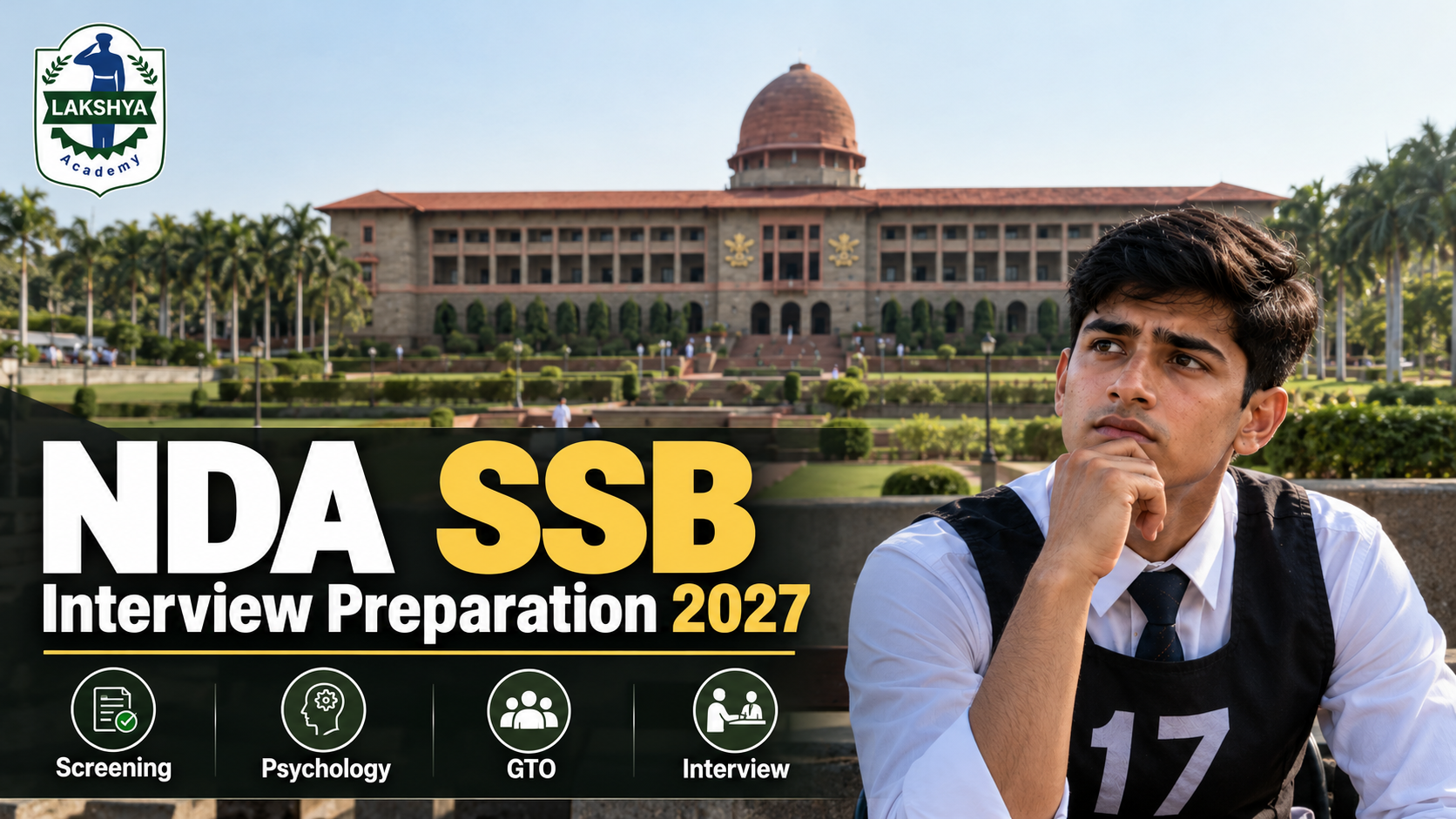
Clearing the NDA written examination is a major achievement, but the next important step is preparing for the NDA SSB Interview 2027. Candidates aspiring to join the Indian Army, Navy or Air Force must understand the SSB selection process and prepare for its different assessments.
The Services Selection Board (SSB) evaluates a candidate’s personality, communication skills, decision-making ability, teamwork, leadership potential and suitability for a career as an officer in the Indian Armed Forces.
If you are preparing for NDA 1 2027 or NDA 2 2027, this guide by The Lakshya Academy will help you understand the NDA SSB interview process, including screening tests, psychology tests, GTO tasks, the personal interview and the conference.
What Is the NDA SSB Interview?
The NDA SSB Interview is a personality assessment conducted for candidates who qualify for the next stage of selection after the written examination.
Unlike a conventional job interview, the SSB process assesses candidates through a combination of individual tests, group activities, psychological assessments and personal interaction.
The main components include:
Screening tests
Psychological tests
Group Testing Officer (GTO) tasks
Personal interview
Conference
The assessment is designed to evaluate Officer Like Qualities (OLQs) and a candidate’s potential to undergo officer training. Candidates should prepare for the entire process rather than focusing on only one test.
NDA SSB Interview Process 2027: Stage-Wise Details
1. NDA SSB Screening Test
Screening is the first major stage of the SSB selection process. Candidates who clear this stage continue with the remaining assessments.
The screening stage includes the following tests.
Officer Intelligence Rating (OIR) Test
The OIR test assesses verbal and non-verbal reasoning ability. Candidates may encounter questions involving:
Number and letter series
Analogies
Coding and decoding
Classification
Logical reasoning
Figure-based reasoning
Spatial and pattern-based questions
To prepare for OIR, practise reasoning questions regularly and work on both speed and accuracy. Timed practice sets can help you become familiar with different question formats.
Picture Perception and Discussion Test (PPDT)
In PPDT, candidates observe a picture, form a story based on their perception and participate in a group discussion.
Preparation should focus on:
Observing the picture carefully
Identifying the main character and the situation
Developing a logical and realistic story
Explaining the character’s actions clearly
Listening to other candidates
Contributing constructively to the group discussion
A good PPDT story should be coherent and realistic. Avoid forcing an unnecessarily dramatic or heroic ending into every story.
2. NDA SSB Psychology Tests
Candidates who clear screening proceed to the next stage of assessment. Psychological tests are used to understand how candidates perceive situations, respond to challenges and express their thoughts.
The main psychology tests include TAT, WAT, SRT and Self-Description.
Thematic Apperception Test (TAT)
In TAT, candidates write stories based on pictures presented to them. The purpose is to assess how they interpret situations and develop responses through their stories.
For preparation, practise creating stories with a clear situation, practical action and logical outcome. Focus on realistic problem-solving instead of memorising standard stories.
Word Association Test (WAT)
In WAT, candidates respond to a series of words within the time allowed.
Regular practice can help improve quick thinking and the ability to express ideas clearly. Candidates should aim to write natural, meaningful responses rather than memorised quotations.
Situation Reaction Test (SRT)
SRT presents candidates with everyday or challenging situations and asks them to write how they would respond.
Practise making responses that are practical, responsible and appropriate to the situation. Effective responses should demonstrate sensible decision-making, initiative and awareness of consequences.
Self-Description Test (SD)
The Self-Description Test asks candidates to describe themselves from different perspectives, such as how their parents, teachers, friends or they themselves view their personality.
Prepare by reflecting honestly on your strengths, areas for improvement, habits, achievements and goals. Your responses should be consistent with your real-life experiences.
3. NDA SSB GTO Tasks
Group Testing Officer tasks evaluate how candidates behave in group situations, approach practical challenges, communicate ideas and work with others.
GTO activities may include group discussions, planning exercises, outdoor tasks and individual activities.
Important GTO tasks include:
Group Discussion (GD)
Candidates discuss a given topic with other members of the group.
To prepare for GD:
Follow current affairs and important national and international issues.
Organise your thoughts before speaking.
Present relevant facts and examples.
Listen to different viewpoints.
Communicate confidently without dominating others.
The aim is to contribute meaningfully to the discussion while respecting other candidates.
Group Planning Exercise (GPE)
In GPE, candidates analyse a situation involving multiple problems and prepare a practical plan.
Practise identifying priorities, allocating resources, managing time and explaining your plan logically. The ability to consider safety, urgency and available resources is important.
Progressive Group Task (PGT)
PGT involves solving obstacles as a group with the help of permitted structures and materials.
Candidates should focus on cooperation, practical thinking, clear communication and following the task instructions.
Half Group Task (HGT)
HGT is similar in principle to PGT, but candidates work in a smaller group. It provides an opportunity to participate actively and demonstrate their approach to problem-solving.
Individual Obstacles
Candidates attempt a set of physical obstacles within the prescribed conditions.
Regular physical conditioning, agility, coordination and familiarity with basic exercise can support preparation. Candidates should build fitness gradually and follow all safety instructions.
Command Task
In the Command Task, a candidate takes responsibility for completing an assigned obstacle or problem and may select group members to assist.
This task requires planning, clear instructions, practical decision-making and effective coordination.
Final Group Task (FGT)
FGT is another group obstacle-solving activity. Candidates should focus on teamwork, contributing useful ideas and completing the assigned task within the permitted rules.
4. NDA SSB Personal Interview
The personal interview is an important part of the SSB assessment. The Interviewing Officer may ask questions about a candidate’s background, education, interests, achievements, daily routine, family, friends and awareness of current affairs.
Common areas of preparation include:
Personal information and family background
School life and academic performance
Hobbies and extracurricular activities
Strengths and areas for improvement
Reasons for choosing a career in the Armed Forces
Awareness of the Army, Navy and Air Force
Current national and international affairs
Situational and decision-making questions
How to prepare for the NDA SSB personal interview
Start by reviewing your personal information and experiences. Be prepared to explain your interests, achievements and decisions honestly.
Practise answering questions in clear, simple language. Avoid memorising lengthy answers or claiming achievements that you cannot explain. If you do not know an answer, respond honestly rather than inventing information.
Confidence, self-awareness and consistency are more useful than rehearsed responses.
5. NDA SSB Conference
The conference is the final stage of the SSB assessment. Assessors review the candidate’s overall performance before reaching a recommendation.
Candidates may be asked a few questions about their experience at the selection centre. The conference is not simply a test of how confidently a candidate answers these questions; the decision considers the overall assessment.
Candidates should remain calm, polite and composed throughout this stage.
How to Prepare for NDA SSB Interview 2027
A structured preparation plan can help candidates become familiar with the process and improve their performance.
1. Understand the Complete SSB Process
Learn about screening, psychology tests, GTO activities, the personal interview and the conference before beginning intensive preparation.
Understanding the purpose of each test will help you practise more effectively.
2. Practise OIR and PPDT Daily
Set aside time for reasoning questions and picture-based story writing. Review your answers to identify problems with clarity, logic and time management.
For PPDT discussions, practise speaking clearly, listening actively and expressing your points respectfully.
3. Build Your Psychology Test Practice
Practise TAT, WAT, SRT and Self-Description under realistic time limits. Focus on honest, relevant and practical responses instead of memorising templates.
4. Improve Communication Skills
Read reliable news sources, discuss current affairs and practise explaining your views in a structured manner.
Good communication includes listening, understanding the question, responding clearly and respecting different opinions.
5. Develop Physical Fitness
Include appropriate cardiovascular exercise, strength training, mobility and recovery in your routine. Increase exercise intensity gradually according to your fitness level.
Physical preparation should support your overall well-being and help you approach outdoor activities safely.
6. Prepare for the Personal Interview
Review your academic background, hobbies, interests, achievements and personal goals. Think about the experiences that have shaped your decisions and the reasons you want to join the Armed Forces.
Practise answering questions naturally and honestly.
7. Stay Updated with Current Affairs
Follow important developments in India and the world, especially national security, defence, international relations, science and technology.
Focus on understanding the issue rather than memorising isolated facts.
Common Mistakes to Avoid During NDA SSB Preparation
Many candidates spend time memorising model answers without understanding the purpose of the assessment. Avoid these common mistakes:
Memorising stories and using them regardless of the picture.
Dominating group discussions or refusing to listen.
Giving unrealistic responses in psychology tests.
Exaggerating personal achievements during the interview.
Ignoring physical fitness and communication practice.
Depending entirely on coaching notes without practising independently.
Treating each SSB test as a separate performance instead of preparing consistently.
A better approach is to develop self-awareness, practise regularly and learn from feedback.
Can You Prepare for NDA SSB Interview 2027 in Advance?
Yes. Candidates can begin preparing before the written examination results are announced.
Early preparation allows aspirants to build reasoning ability, improve communication, practise psychological tests and become familiar with group activities.
Candidates should balance SSB preparation with their NDA written examination studies. Once shortlisted, they can focus more intensively on the assessment process and the instructions provided by the relevant authorities.
NDA SSB Interview Preparation at The Lakshya Academy
Preparing for the NDA SSB Interview requires an understanding of the assessment process, consistent practice and constructive feedback.
The Lakshya Academy provides defence-examination preparation and SSB-related guidance for aspirants aiming to join the Indian Armed Forces.
Candidates can explore the academy’s available courses and preparation resources through the official website:
Website: www.lakshyaacademy.co.in
A structured preparation approach can help aspirants understand the tests, practise their communication and build confidence before attending the SSB.
Frequently Asked Questions About NDA SSB Interview Preparation 2027
1. What is the NDA SSB Interview process for 2027?
The process includes screening tests, followed by psychology tests, GTO tasks, a personal interview and a conference for candidates who clear the preceding stage. Follow the official instructions applicable to your selection centre.
2. What happens in the NDA SSB screening test?
Screening traditionally includes the Officer Intelligence Rating (OIR) test and the Picture Perception and Discussion Test (PPDT). Candidates are shortlisted according to the applicable screening procedure.
3. Which psychology tests are conducted during SSB?
The commonly described psychology tests are TAT, WAT, SRT and Self-Description. Candidates should practise each test while following the instructions given at the selection centre.
4. What are GTO tasks in the SSB interview?
GTO tasks assess candidates through group discussions, planning exercises, obstacle tasks and other activities. They help assess teamwork, communication, practical thinking and leadership potential.
5. What questions are asked in the NDA SSB personal interview?
Questions may cover education, family, hobbies, achievements, current affairs, personal experiences and motivation for joining the Armed Forces. Candidates should prepare to discuss their backgrounds honestly.
6. Can I prepare for the NDA SSB interview without coaching?
Candidates can study the process and practise independently using reliable resources. Structured guidance and feedback may help identify areas for improvement, but no course can guarantee recommendation.
7. How many days does the SSB process take?
The process is commonly described as a multi-day assessment, with Stage I screening followed by Stage II assessments for shortlisted candidates. Check your call letter and official instructions for the schedule applicable to your entry.
8. How can I improve my chances in the NDA SSB interview?
Understand the test formats, practise regularly, improve communication, stay physically active, develop self-awareness and learn to work constructively with others. Focus on genuine improvement rather than trying to imitate a particular personality.
Conclusion
The NDA SSB Interview Preparation 2027 journey requires more than practising interview questions. Candidates need to understand screening, psychology tests, GTO tasks, the personal interview and the conference while developing communication, teamwork, decision-making and self-awareness.
Start early, practise consistently and prepare honestly for every stage. With a structured approach and a clear understanding of the selection process, you can work towards your goal of becoming an officer in the Indian Armed Forces.
The Lakshya Academy encourages defence aspirants to begin their preparation with a clear plan and a commitment to continuous improvement.