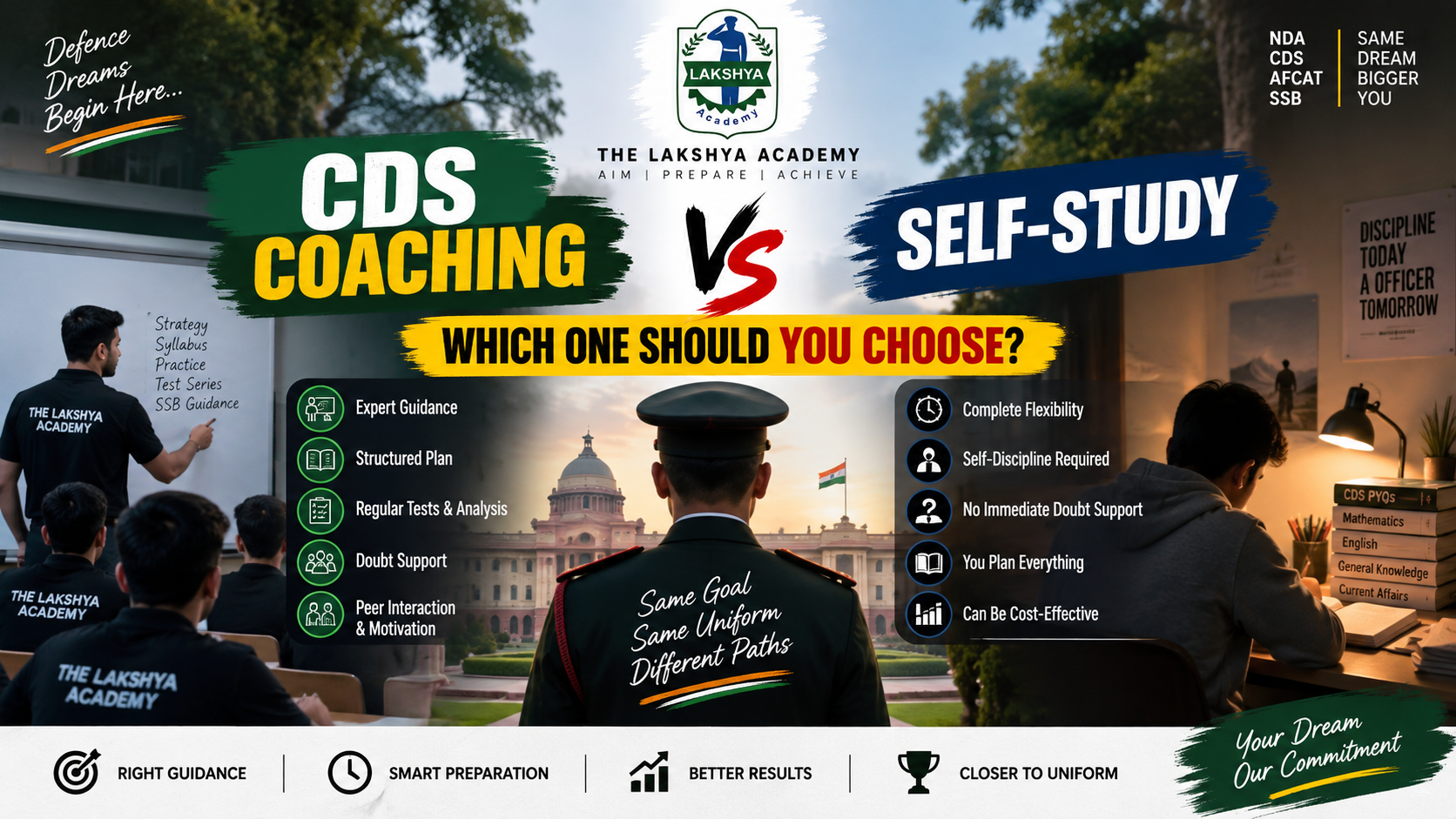
Preparing for the Combined Defence Services (CDS) Examination is a serious commitment. The syllabus is broad, competition is strong, negative marking demands accuracy, and success in the written examination is followed by the SSB interview and medical examination. One of the first questions asked by beginners is: Should I join CDS coaching or prepare through self-study?
There is no single answer that is correct for every aspirant. Coaching can offer structure, guidance, testing, and accountability, while self-study can provide flexibility, independence, and lower cost. The right choice depends on your academic foundation, discipline, available time, learning style, budget, and current level of preparation.
This complete guide by The Lakshya Academy compares CDS coaching vs self-study honestly so that you can choose the approach that best supports your goal of becoming an officer in the Indian Armed Forces.
Understanding the Demands of CDS Preparation
Before comparing the two approaches, understand what CDS preparation requires. Depending on the academy selected, candidates prepare for English, General Knowledge, and Elementary Mathematics. Candidates targeting OTA take English and General Knowledge, while candidates targeting IMA, INA, or AFA also prepare for Elementary Mathematics, subject to the current official notification.
Effective preparation normally involves:
Understanding the official syllabus and paper pattern
Building conceptual clarity
Covering static General Knowledge and current affairs
Solving previous-year questions
Revising formulas, facts, grammar rules, and vocabulary
Taking sectional and full-length mock tests
Analysing mistakes and improving accuracy
Developing time-management skills
Preparing gradually for the SSB interview
Whether you choose coaching or self-study, these requirements remain the same. Only the method of completing them changes.
What Is CDS Coaching?
CDS coaching is a guided preparation system in which teachers and mentors organise the syllabus, explain concepts, provide study material, conduct tests, address doubts, and help students monitor their progress.
Coaching may be offered through:
Classroom programmes
Live online classes
Recorded courses
Test series
Subject-specific courses
Short revision batches
Written examination and SSB-integrated guidance
The quality of coaching depends on the faculty, batch size, teaching method, relevance of study material, testing system, and individual support available to students.
What Is Self-Study for CDS?
Self-study means planning and managing your preparation independently. You select resources, create a timetable, study concepts, make notes, solve PYQs, take mock tests, and evaluate your performance without depending on a regular classroom programme.
Self-study does not mean studying without any external help. A self-study aspirant may still use books, online lectures, official question papers, current-affairs sources, test series, or occasional mentorship. The main difference is that the student remains responsible for designing and executing the preparation plan.
CDS Coaching vs Self-Study: Quick Comparison
Factor
CDS Coaching
Self-Study
Study structure
Pre-planned schedule and syllabus sequence
Student creates and manages the plan
Flexibility
Fixed or semi-fixed timings
High flexibility
Doubt resolution
Faculty support is usually available
Requires independent research or external help
Discipline
Regular classes and tests create accountability
Depends mainly on self-discipline
Resources
Curated notes, classes, PYQs, and tests
Student must select reliable sources
Feedback
Teacher and test-based feedback
Mostly self-analysis unless mentorship is added
Cost
Usually higher
Usually lower
Pace
Often designed for the batch
Fully controlled by the student
Peer environment
Access to fellow aspirants
May be limited
Suitability
Helpful for beginners or students needing structure
Effective for disciplined, independent learners
Advantages of Joining CDS Coaching
1. A Structured Preparation Plan
Beginners often struggle to decide where to start. A well-designed coaching programme divides the syllabus into manageable units and provides a sequence for concepts, practice, revision, and tests. This reduces confusion and saves planning time.
2. Expert Explanation of Difficult Topics
Some grammar rules, mathematical concepts, scientific topics, and current-affairs connections can be difficult to understand through books alone. An experienced teacher can explain the concept, demonstrate its application, and identify common examination traps.
3. Faster Doubt Resolution
Unresolved doubts weaken later topics. Coaching provides access to teachers or mentors who can clarify errors before they become habits. This is particularly helpful for candidates who have been away from Mathematics or English grammar for a long time.
4. Regular Tests and Performance Analysis
A useful coaching system does more than conduct classes. It includes topic tests, sectional tests, mock examinations, and detailed analysis. Regular evaluation helps students identify weak areas and improve speed, accuracy, and question selection.
5. Accountability and Consistency
Fixed classes, deadlines, homework, and test schedules create external discipline. This can be valuable for students who frequently postpone study targets or lose consistency when preparing alone.
6. Competitive Peer Environment
Studying with other serious aspirants can improve motivation and expose you to different problem-solving methods. Group discussions and peer comparison can also help you understand your current level, provided the environment remains positive and focused.
7. Guidance Beyond the Written Examination
An institute that also understands the SSB process can help students see the CDS journey as a complete selection process. Awareness, communication, fitness, self-understanding, and officer-like behaviour should develop gradually rather than beginning only after the written result.
Limitations of CDS Coaching
Coaching is not automatically successful for every student. Its limitations may include:
Course fees and travel expenses
Fixed timings that may not suit working or college-going candidates
Batch pace that may feel too fast or too slow
Large classes with limited individual attention
Dependence on lectures without sufficient self-practice
Excessive material that becomes difficult to revise
Joining coaching does not replace self-study. Even the best classroom programme requires daily revision, PYQ practice, and independent mock-test analysis.
Advantages of CDS Self-Study
1. Complete Flexibility
Self-study allows you to choose when, where, and how long you study. This is especially useful for college students, working professionals, and candidates managing family responsibilities.
2. Personalised Pace
You can spend more time on weak topics and move quickly through areas you already understand. A candidate strong in English but weak in Mathematics can adjust the timetable accordingly.
3. Lower Financial Cost
Self-study can be completed with a limited set of books, PYQs, current-affairs resources, and a test series. It is often the more economical option for students with a restricted budget.
4. Development of Independent Learning
Planning, researching, solving doubts, and analysing performance independently can build strong learning habits. These skills remain useful beyond one examination.
5. Freedom to Select Resources
Self-study aspirants are not restricted to one institute’s notes or teaching style. They can choose the resources that best match their level. However, this freedom must be controlled to avoid collecting too much material.
Limitations of Self-Study
Self-study can become ineffective when a candidate lacks planning or discipline. Common problems include:
Uncertainty about where to begin
Using too many books and online channels
Delayed doubt resolution
Irregular study habits
Avoiding difficult subjects
Postponing mock tests
Inaccurate self-assessment
Lack of expert feedback
Feeling isolated or losing motivation
These problems do not mean that self-study cannot work. They mean that it requires a clear system and honest self-monitoring.
Who Should Choose CDS Coaching?
Coaching may be the better choice if:
You are a complete beginner and need a roadmap.
Your basic Mathematics, English, or General Knowledge foundation is weak.
You struggle to maintain discipline without external accountability.
You frequently get stuck on doubts.
You need regular tests and expert performance feedback.
You have limited preparation time and want organised coverage.
You learn better through classroom explanations and interaction.
You want coordinated guidance for written preparation and SSB awareness.
The decision should still be based on the quality of the programme. Do not join an institute only because of advertisements, unrealistic claims, or the size of the study material.
Who Should Choose Self-Study?
Self-study may be suitable if:
Your fundamentals are reasonably strong.
You understand the syllabus and can create a realistic plan.
You are consistent without supervision.
You can identify and correct your mistakes.
You have limited financial resources.
Your college or work schedule does not match fixed class timings.
You already know which books, PYQs, and tests to use.
You have previously prepared for a similar competitive examination.
A disciplined self-study aspirant with limited, high-quality resources can perform extremely well.
The Hybrid Approach: Coaching Plus Self-Study
For many candidates, the most effective solution is not an extreme choice between full coaching and completely independent preparation. A hybrid approach combines structured guidance with strong self-study.
Examples include:
Joining a foundation course but revising independently every day
Taking coaching only for a weak subject such as Mathematics
Using self-study for concepts and joining a test series for evaluation
Taking mentorship for planning and doubt support
Using recorded classes around a college or work schedule
Preparing for the written examination independently while taking specialised SSB guidance later
Coaching provides direction; self-study converts that direction into performance. The two methods can complement each other when used intelligently.
How to Evaluate a CDS Coaching Institute
Before enrolling, examine the institute carefully.
Check the Teaching Quality
Attend a demonstration class where possible. Evaluate whether the teacher explains concepts clearly, solves examination-relevant questions, and encourages doubts.
Review the Course Structure
Ask whether the programme includes:
Complete syllabus coverage
Topic-wise PYQs
Regular sectional tests
Full-length mock tests
Test analysis and feedback
Current-affairs support
Revision sessions
Doubt resolution
SSB orientation or guidance
Examine Batch Size and Support
Very large batches may reduce individual attention. Ask how doubts are handled and whether teachers or mentors monitor student performance.
Avoid Unrealistic Guarantees
No genuine institute can guarantee final selection. Selection depends on eligibility, written performance, SSB performance, medical fitness, vacancies, and merit. Choose an institute that offers a credible process rather than exaggerated promises.
Consider Location, Time, and Total Cost
Include travel time, accommodation, books, and test-series charges when evaluating affordability. The cheapest course is not always the best value, and the most expensive programme is not automatically the highest quality.
How to Make Self-Study Effective
If you choose self-study, follow a disciplined system.
Step 1: Understand the Syllabus
Create a topic checklist and mark each chapter as not started, in progress, completed, or revised.
Step 2: Take a Diagnostic Test
Attempt a previous-year paper to identify your strong and weak areas.
Step 3: Limit Your Resources
Use one reliable primary source for each subject, supported by PYQs and tests. Avoid changing books repeatedly.
Step 4: Create Weekly Targets
Set measurable targets such as chapters completed, questions solved, tests attempted, and revision sessions finished.
Step 5: Solve PYQs Regularly
Do not wait until the syllabus is complete. Solve topic-wise PYQs immediately after studying each chapter.
Step 6: Maintain an Error Notebook
Record formulas, grammar rules, facts, careless mistakes, and concepts you repeatedly forget.
Step 7: Take Timed Tests
Begin with sectional tests and progress to full-length papers. Analyse every test instead of only checking the score.
Step 8: Review Progress Monthly
Compare your scores, accuracy, syllabus completion, and revision quality. Change the plan when evidence shows that something is not working.
A Decision Checklist for Aspirants
Answer these questions honestly:
Can I study consistently without supervision?
Do I understand the complete syllabus and paper requirements?
Are my fundamentals strong enough for independent learning?
Can I resolve doubts quickly?
Do I analyse my mistakes objectively?
Can I afford coaching without creating unnecessary financial pressure?
Does a suitable coaching programme fit my schedule?
Do I need a competitive peer environment?
Have my previous self-study attempts produced measurable improvement?
Would subject-specific help be enough instead of a complete course?
If most answers show that you are organised, consistent, and academically prepared, self-study may be sufficient. If you need structure, explanation, feedback, and accountability, quality coaching may save time and reduce confusion.
Common Myths About Coaching and Self-Study
Myth 1: Coaching Guarantees Selection
Coaching can provide guidance and support, but results depend on the candidate’s consistent effort and performance throughout the selection process.
Myth 2: Self-Study Means Studying Without Help
Self-study candidates can use lectures, test series, mentoring, and doubt sessions. They simply manage the overall plan independently.
Myth 3: More Study Material Means Better Preparation
Success depends on understanding and revising relevant material-not accumulating books and PDFs.
Myth 4: Long Study Hours Always Produce Better Results
Focused sessions, question practice, revision, and analysis are more important than merely counting hours.
Myth 5: SSB Preparation Should Start After the Written Result
Communication, awareness, fitness, teamwork, and self-understanding develop over time. Basic development should begin during written preparation.
How The Lakshya Academy Supports CDS Aspirants
The Lakshya Academy supports defence aspirants through structured CDS preparation, concept-focused teaching, previous-year question practice, regular testing, doubt support, revision planning, and guidance for the broader selection journey.
For students looking for CDS coaching in Delhi, the objective should be to find an environment that improves consistency, clarity, accuracy, confidence, and exam temperament. Effective mentoring should help students become more independent over time rather than making them completely dependent on classes.
Final Verdict: CDS Coaching or Self-Study?
Choose CDS coaching if you require a structured roadmap, regular accountability, expert explanation, doubt support, and performance feedback. Choose self-study if your fundamentals are strong, you are disciplined, your schedule demands flexibility, and you can evaluate your progress honestly.
For many aspirants, a hybrid approach is the most practical option: use coaching or mentorship where it adds clear value, and make daily self-study the foundation of preparation.
The deciding factor is not where you study but how consistently you learn, practise, revise, and improve. Select the method that addresses your actual weaknesses-not the method that appears most popular.