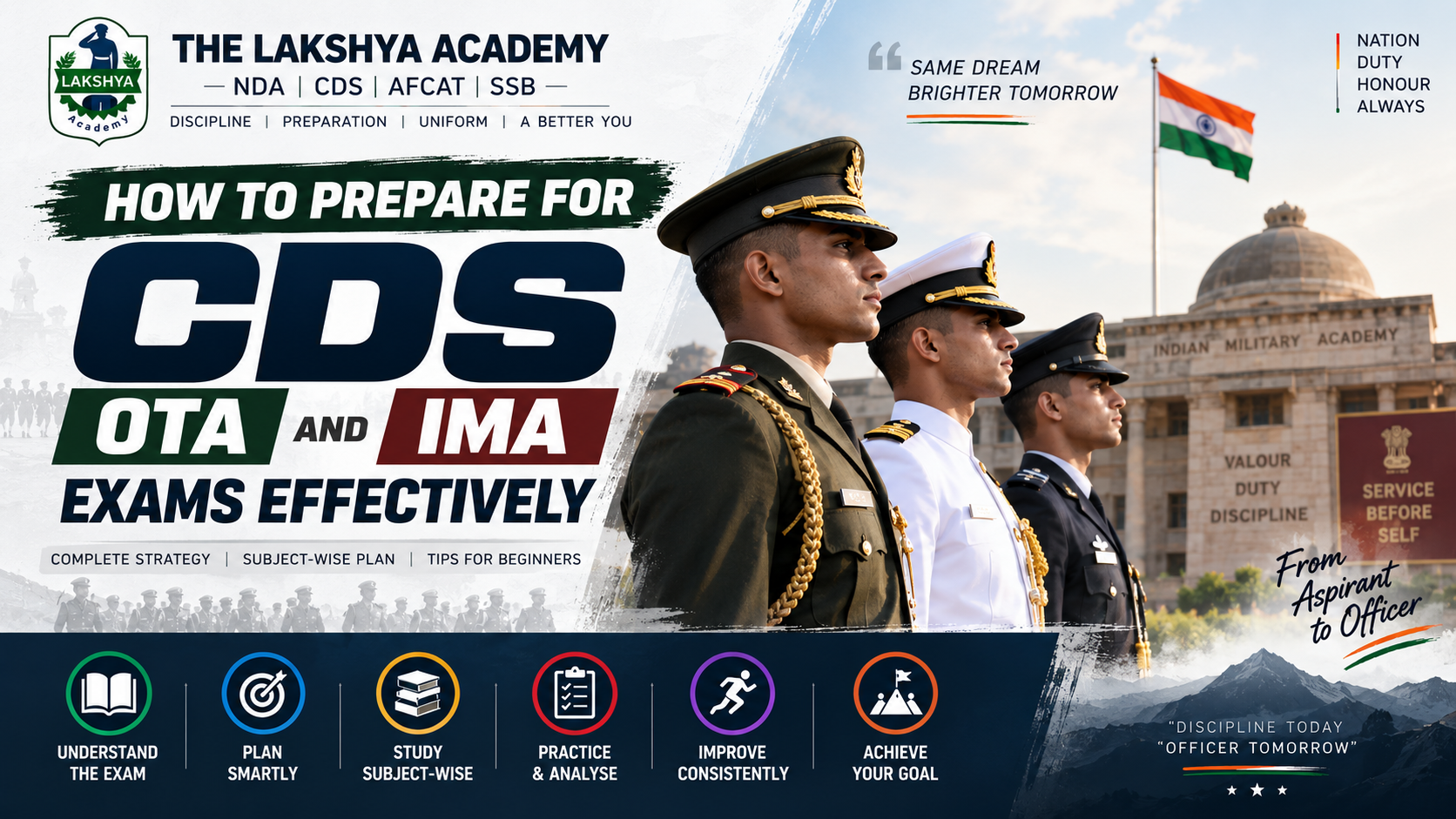
The Combined Defence Services (CDS) Examination is one of the most respected routes for graduates who want to become officers in the Indian Armed Forces. Among the choices available through CDS, the Officers Training Academy (OTA) and the Indian Military Academy (IMA) attract thousands of serious aspirants every year. Although both entries are part of the same examination, their written-paper requirements, training routes, and preparation priorities are not identical.
An effective CDS OTA and IMA preparation strategy must therefore begin with a clear understanding of the target academy. IMA aspirants prepare for English, General Knowledge, and Elementary Mathematics, whereas OTA aspirants prepare for English and General Knowledge. Both groups must also be ready for the SSB interview and medical examination after the written stage.
This guide by The Lakshya Academy explains how to prepare for CDS OTA and IMA effectively, choose the right study resources, create a practical timetable, use previous-year questions, improve accuracy, and begin SSB preparation at the right time.
Important: Candidates should verify eligibility, vacancies, dates, paper instructions, and other conditions in the latest notification on the official UPSC website, as these details may change.
Understanding CDS OTA and IMA
Before starting your preparation, understand what each entry represents.
What Is IMA?
The Indian Military Academy trains candidates selected for a Permanent Commission in the Indian Army. Candidates applying for IMA through CDS must take three written papers: English, General Knowledge, and Elementary Mathematics.
What Is OTA?
The Officers Training Academy trains candidates selected for a Short Service Commission in the Indian Army. For OTA through CDS, the written examination consists of English and General Knowledge; there is no Elementary Mathematics paper.
The exact eligibility rules-including age, educational qualification, marital status, and applicable courses-must be checked in the current UPSC notification.
CDS OTA vs IMA Exam Pattern
| Academy | Written Papers | Marks | Total Written Marks |
| IMA | English, General Knowledge, Elementary Mathematics | 100 | 300 |
| OTA | English, General Knowledge | 100 | 300 |
The papers are objective in nature and involve negative marking for incorrect answers. This means that candidates cannot depend on random guessing. A high-quality attempt with strong accuracy is more useful than attempting every question without confidence.
Step 1: Decide Whether You Are Targeting OTA, IMA, or Both
Your first decision should be based on eligibility and career preference. If you are applying for both IMA and OTA, you must prepare all three subjects because your IMA preference requires Mathematics. If you are eligible for and targeting only OTA, you can focus your written preparation entirely on English and General Knowledge.
Ask yourself:
Do I meet the current eligibility conditions for IMA or OTA?
Am I seeking a Permanent Commission or Short Service Commission route?
Is Mathematics part of my required written examination?
How much preparation time is available before the examination?
Which subject is currently my weakest?
Once the target is clear, you can divide your study hours correctly.
Step 2: Study the Syllabus Before Choosing Books
One of the biggest mistakes made by CDS beginners is collecting too many books before understanding the syllabus. Print or write down the official syllabus and break it into smaller topics.
English Syllabus Preparation Areas
Your English preparation should cover:
Parts of speech and grammar rules
Spotting errors
Sentence improvement
Fill in the blanks
Synonyms and antonyms
Idioms and phrases
One-word substitution
Ordering of words and sentences
Reading comprehension
Vocabulary and usage
General Knowledge Preparation Areas
Build your General Knowledge plan around:
Indian history
Indian polity and the Constitution
Geography
Economics
General science
Environment and ecology
Current affairs
Defence-related developments
Important national and international organisations
Elementary Mathematics Areas for IMA
IMA aspirants should create a separate plan for:
Arithmetic
Algebra
Geometry
Mensuration
Trigonometry
Statistics
Use the official syllabus as a boundary. It prevents you from spending valuable time on material that is not relevant to the examination.
Step 3: Take a Diagnostic Test
Before starting a long study plan, attempt one recent CDS previous-year paper under timed conditions. An initial low score is not a problem. The purpose is to identify your current level.
Record the following for each subject:
Questions attempted
Correct answers
Incorrect answers
Questions left unattempted
Time taken
Strong topics
Weak topics
Mistakes caused by lack of knowledge
Mistakes caused by hurry or confusion
This analysis will show whether you need concept-building, more revision, improved calculation speed, or better question selection.
Step 4: Create a Practical Study Timetable
A timetable should be sustainable. Do not create a ten-hour plan if you can realistically study for only four hours.
Sample Timetable for OTA Aspirants
English concepts and practice: 90 minutes
Static General Knowledge: 90 minutes
Current affairs: 45 minutes
PYQs or revision: 45 minutes
Sample Timetable for IMA Aspirants
Elementary Mathematics: 2 hours
English: 75 minutes
Static General Knowledge: 90 minutes
Current affairs: 30–45 minutes
Revision or PYQs: 45 minutes
College students and working aspirants can divide these sessions between morning and evening. On weekends, take a sectional or full-length test and clear the week’s backlog.
Step 5: Prepare English as a Scoring Subject
English is common to both OTA and IMA, so it should become one of your strongest areas. Improvement requires a combination of grammar, vocabulary, comprehension, and question practice.
Effective English Strategy
Study one grammar rule and solve questions based on it immediately.
Maintain a notebook of common errors and confusing rules.
Learn vocabulary through sentences and context.
Read a quality newspaper editorial or article regularly.
Practise comprehension, sentence ordering, and usage-based questions.
Solve CDS English PYQs topic by topic.
Take timed sectional tests to improve speed.
Do not choose an answer only because it “sounds correct.” Apply the grammar rule and examine the context. During revision, focus on recurring mistakes rather than rereading entire books.
Step 6: Build General Knowledge Systematically
General Knowledge often appears difficult because the syllabus is broad. The solution is not to read everything; it is to follow a structured and revision-friendly approach.
Static GK Strategy
Complete one subject in a logical sequence. For example, study the fundamental concepts of polity before attempting random constitutional questions. Use concise notes for facts, dates, maps, definitions, scientific principles, and frequently confused points.
Current Affairs Strategy
Current affairs should be studied consistently. Focus on significant national and international events, defence developments, government initiatives, reports, appointments, sports, awards, environment, science, and important organisations. Connect every important event with its static background.
For example, when reading about an international organisation, revise its headquarters, members, purpose, and India’s role. This integrated method is more useful than memorising disconnected facts.
GK Revision Strategy
Revise short notes weekly.
Use mixed-topic quizzes.
Mark facts you repeatedly forget.
Revisit maps, timelines, and tables.
Solve previous-year questions after every completed topic.
Avoid using too many monthly magazines and current-affairs channels. Select a limited set of reliable resources and revise them multiple times.
Step 7: Master Mathematics for IMA
Elementary Mathematics is the major difference between IMA and OTA written preparation. IMA aspirants should not postpone Mathematics until the final weeks.
Mathematics Preparation Method
Begin with fundamental concepts and basic examples.
Create a formula notebook.
Solve topic-wise questions without strict timing initially.
Study the reason behind every incorrect answer.
Move to timed practice after building accuracy.
Solve mixed question sets to improve topic recognition.
Attempt full Mathematics papers under exam conditions.
Arithmetic usually provides a useful foundation for further preparation. Geometry, mensuration, algebra, trigonometry, and statistics should then be covered according to your strengths and the official syllabus.
Speed should be developed through repeated practice, not by memorising shortcuts without understanding. Since negative marking applies, calculation accuracy is essential.
Step 8: Make PYQs the Centre of Your Preparation
Previous-year questions show what UPSC actually asks. They help you understand question style, recurring concepts, difficulty level, and common traps.
Follow this three-stage PYQ method:
Stage 1: Topic-Wise PYQs
Solve relevant previous questions immediately after completing a chapter.
Stage 2: Subject-Wise Papers
Attempt complete English, GK, or Mathematics papers to develop speed and concentration.
Stage 3: Full Exam Simulation
Attempt the papers in the correct sequence and time limits under exam-like conditions.
After checking the answers, classify every mistake as a concept error, memory error, calculation error, misreading, guess, or time-pressure error. This classification makes improvement specific and measurable.
Step 9: Follow an Effective Revision Cycle
Revision should begin from the first week. Use a simple cycle:
Daily: Review formulas, vocabulary, facts, and concepts studied that day.
Weekly: Revise completed chapters and analyse the week’s errors.
Monthly: Take cumulative tests and revisit weak subjects.
Create compact final-revision sheets for:
Mathematics formulas
Grammar rules
Vocabulary and idioms
Important historical timelines
Constitutional provisions
Geography maps and facts
Science concepts
Current-affairs highlights
The purpose of notes is fast recall. If your notes are too long to revise, shorten them.
Step 10: Use Mock Tests Correctly
Mock tests are essential, but taking tests without analysis produces limited improvement. Begin with sectional tests and gradually move to full papers.
After every mock, examine:
Net score after negative marking
Accuracy percentage
Time spent per section
Easy questions left unattempted
Risky guesses
Frequently repeated mistakes
Topics requiring revision
Maintain a mock-test tracker. Your goal should be a steady improvement in net score and accuracy—not simply a higher number of attempted questions.
Step 11: Create a Smart Exam-Hall Strategy
Practise your attempt sequence during mocks so that examination-day decisions feel familiar.
Begin with questions you can answer confidently.
Use rounds: easy questions first, moderate questions next, doubtful or lengthy questions last.
Do not remain stuck on one problem.
Read instructions and options carefully.
Avoid random guessing.
Reserve a few minutes for checking the answer sheet.
There is no universal safe number of attempts. The ideal number depends on the paper’s difficulty and your accuracy. Focus on the best possible net score.
Step 12: Begin SSB Preparation Early
Clearing the written examination is only one part of selection. Candidates shortlisted for IMA or OTA must face the Services Selection Board process and meet the prescribed medical standards.
Begin developing:
Clear verbal and written communication
Awareness of national and international issues
Honest self-awareness
Team participation
Decision-making ability
Responsibility and initiative
Physical fitness
Confidence under pressure
Learn the broad structure of screening, psychological tests, group testing, personal interview, and conference. Practise narration, group discussion, reading, and self-reflection, but avoid artificial answers and memorised stories. SSB preparation should help you express your genuine personality more clearly.
A Three-Phase Preparation Plan for OTA and IMA
Phase 1: Foundation
Understand the latest syllabus and paper pattern.
Build concepts in English, GK, and Mathematics where applicable.
Start daily current affairs.
Make short notes.
Phase 2: Practice
Complete topic-wise PYQs.
Take sectional tests.
Improve calculation and reading speed.
Identify repeated mistakes.
Phase 3: Revision and Testing
Revise compact notes and the error notebook.
Attempt full-length mocks.
Refine the exam-hall strategy.
Avoid unnecessary new resources.
Continue fitness and SSB-oriented development.
Common Mistakes to Avoid
Preparing for OTA and IMA without understanding their paper differences
Ignoring the official syllabus and latest notification
Postponing Mathematics despite targeting IMA
Using too many books and online channels
Reading GK without regular revision
Ignoring PYQs
Taking mocks without analysing mistakes
Attempting excessive doubtful questions
Waiting for the written result before learning about SSB
Following an unrealistic timetable
How The Lakshya Academy Helps CDS Aspirants
The Lakshya Academy provides structured support for defence aspirants preparing for CDS OTA and IMA. Beginners benefit from a clear preparation path that combines conceptual teaching, topic-wise practice, previous-year questions, regular testing, doubt support, performance analysis, and guidance for the complete selection journey.
For aspirants seeking CDS coaching in Delhi, disciplined mentorship can help turn a broad syllabus into a practical daily plan. The objective is not merely to complete chapters but to improve accuracy, confidence, revision quality, and exam temperament.
Final Words
The most effective way to prepare for CDS OTA and IMA is to understand your target, follow the official syllabus, strengthen fundamentals, solve PYQs, revise repeatedly, and analyse mock tests honestly. OTA candidates should maximise their performance in English and General Knowledge, while IMA candidates must give consistent attention to Mathematics as well.
Start with a realistic plan and improve one weakness at a time. Consistency, limited resources, active revision, and intelligent question selection can transform a beginner into a confident CDS candidate.