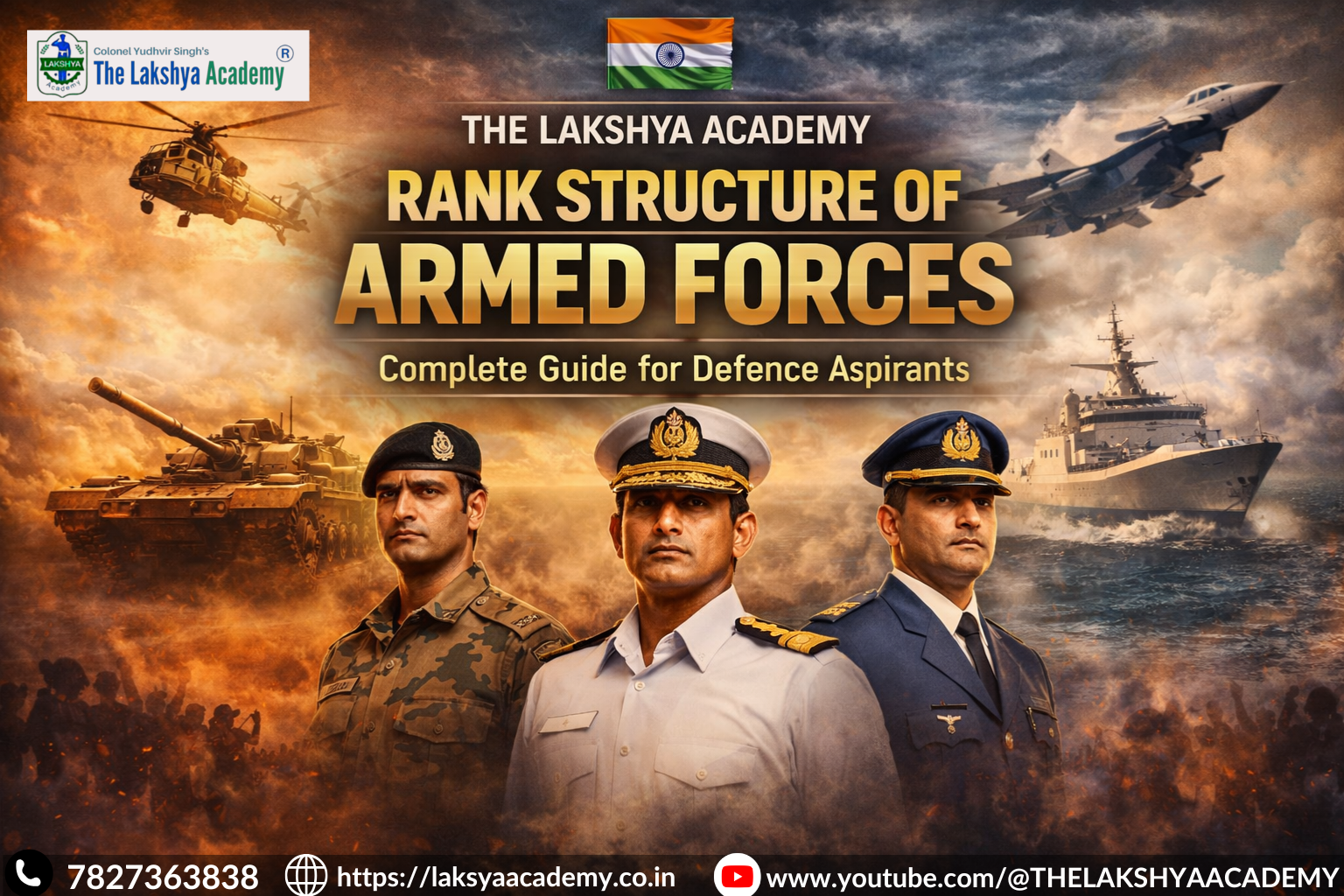
Understand the Rank Hierarchy of Indian Army, Navy, and Air Force
If you are preparing for NDA, CDS, AFCAT, or SSB interviews, understanding the rank structure of the Armed Forces is extremely important. The Indian Armed Forces follow a clear and disciplined hierarchy that defines leadership, responsibility, authority, and command.
For every defence aspirant, knowledge of Indian Army ranks, Indian Navy ranks, and Indian Air Force ranks is not just useful for exams-it is also essential for developing officer-like awareness.
In this blog by The Lakshya Academy, we will explain the rank structure of the Armed Forces in a simple and exam-oriented way.
Why Is Rank Structure Important in the Armed Forces?
The rank system in the Armed Forces ensures smooth functioning, discipline, and chain of command. Every officer and soldier has a designated role and responsibility based on rank.
Importance of rank structure:
- Maintains discipline and order
- Defines leadership and command authority
- Helps in decision-making and operational control
- Ensures clear communication during missions
- Forms the basis of promotion and career growth
For students preparing for defence entrance exams, questions on rank hierarchy of the Indian Armed Forces are commonly asked in:
- NDA written exam
- CDS exam
- AFCAT
- SSB Interview
- General Awareness rounds
Rank Structure of Indian Armed Forces
The Indian Armed Forces are divided into three major services:
- Indian Army
- Indian Navy
- Indian Air Force
Each force has its own rank structure, but the hierarchy is broadly equivalent.
1. Indian Army Rank Structure
The Indian Army rank structure is divided into:
- Commissioned Officers
- Junior Commissioned Officers (JCOs)
- Other Ranks (Soldiers)
A. Commissioned Officer Ranks in Indian Army
These are the ranks held by officers who lead troops, command units, and make strategic decisions.
Indian Army Officer Ranks (Highest to Lowest)
1. Field Marshal
- Highest honorary rank in the Indian Army
- Awarded only in exceptional circumstances
- A five-star rank
2. General
- Chief of Army Staff usually holds this rank
- Commands the entire Army at the highest level
3. Lieutenant General
- Commands corps and high-level formations
- Senior three-star officer
4. Major General
- Commands divisions
- Two-star rank
5. Brigadier
- Commands brigades
- One-star rank
6. Colonel
- Senior administrative and command role
- Often commands regiments or battalions
7. Lieutenant Colonel
- Mid-senior field command rank
- Important leadership appointment
8. Major
- Responsible for operations, training, and administration
- Key role in unit-level leadership
9. Captain
- Commands companies or serves in staff roles
- Important junior officer rank
10. Lieutenant
- Entry-level commissioned officer rank
- Usually the first rank after commissioning
B. Junior Commissioned Officer (JCO) Ranks in Indian Army
JCOs form the backbone between officers and soldiers.
Indian Army JCO ranks:
- Subedar Major
- Subedar
- Naib Subedar
These ranks carry experience, field wisdom, and troop management capability.
C. Other Ranks (Soldier Ranks) in Indian Army
These are non-commissioned ranks and soldier-level positions.
Indian Army soldier ranks:
- Havildar
- Naik
- Lance Naik
- Sepoy
These ranks are crucial in execution, field operations, and combat deployment.
2. Indian Navy Rank Structure
The Indian Navy rank structure also includes officers and sailors. Navy ranks differ in title from the Army but hold equivalent authority.
A. Commissioned Officer Ranks in Indian Navy
Indian Navy Officer Ranks (Highest to Lowest)
1.Admiral of the Fleet
- Ceremonial / honorary rank
- Equivalent to Field Marshal
2. Admiral
- Chief of Naval Staff generally holds this rank
- Highest active rank in the Navy
3. Vice Admiral
- Senior three-star rank
- Commands major naval formations
4. Rear Admiral
- Two-star rank
- Important command and staff role
5. Commodore
- One-star rank
- Commands naval groups and establishments
6. Captain
- Commands warships or shore establishments
- Senior officer rank
7. Commander
- Mid-level command rank
- Responsible for ships, units, or departments
8. Lieutenant Commander
- Junior-middle level officer rank
9. Lieutenant
- Important early-career officer rank
10. Sub Lieutenant
- Entry-level commissioned officer in Navy
B. Sailor Ranks in Indian Navy
- Indian Navy Sailor Rank Structure
- Master Chief Petty Officer First Class
- Master Chief Petty Officer Second Class
- Chief Petty Officer
- Petty Officer
- Leading Seaman
- Seaman I
- Seaman II
These personnel are essential for technical operations, maritime duties, and naval combat readiness.
Indian Air Force Rank Structure
The Indian Air Force rank structure is unique and aviation-oriented. Like the Army and Navy, it has officer and airmen categories.
A. Commissioned Officer Ranks in Indian Air Force
Indian Air Force Officer Ranks (Highest to Lowest)
1. Marshal of the Air Force
- Highest honorary rank
- Equivalent to Field Marshal and Admiral of the Fleet
2. Air Chief Marshal
- Chief of Air Staff generally holds this rank
- Highest active rank in the Air Force
3. Air Marshal
- Three-star rank
- Commands major operational formations
4. Air Vice Marshal
- Two-star rank
5. Air Commodore
- One-star rank
6. Group Captain
- Senior officer rank
- Commands important units and stations
7. Wing Commander
- Mid-level command rank
- Commonly known among defence aspirants
8. Squadron Leader
- Key officer rank in operational and administrative roles
9. Flight Lieutenant
- Junior officer rank
10. Flying Officer
- Entry-level commissioned officer rank
B. Airmen Ranks in Indian Air Force
- Indian Air Force Airmen Rank Structure
- Master Warrant Officer
- Warrant Officer
- Junior Warrant Officer
- Sergeant
- Corporal
- Leading Aircraftman
- Aircraftman
These personnel handle technical, support, operational, and aviation-related tasks.
Equivalent Rank Structure of Army, Navy, and Air Force
For defence aspirants, it is very important to understand the equivalent ranks of the three Armed Forces.
Equivalent Officer Ranks Table
Indian Army Indian Navy Indian Air Force
Field Marshal Admiral of the Fleet Marshal of the Air Force
General Admiral Air Chief Marshal
Lieutenant General Vice Admiral Air Marshal
Major General Rear Admiral Air Vice Marshal
Brigadier Commodore Air Commodore
Colonel Captain Group Captain
Lieutenant Colonel Commander Wing Commander
Major Lieutenant Commander Squadron Leader
Captain Lieutenant Flight Lieutenant
Lieutenant Sub Lieutenant Flying Officer
This comparison is highly useful for:
- SSB interview preparation
- General knowledge for NDA/CDS
- Defence personality development
- Military awareness
How Are Promotions Given in the Armed Forces?
Promotion in the Indian Armed Forces depends on multiple factors such as:
- Length of service
- Performance and Annual Confidential Reports
- Professional courses and training
- Operational achievements
- Selection boards
- Leadership qualities
As officers rise in rank, their responsibilities shift from leading small teams to handling strategic command and national security responsibilities.
Ranks and Leadership: What Defence Aspirants Should Learn
The rank structure of the Armed Forces is not just a list of titles. It reflects the values of:
- Leadership
- Discipline
- Responsibility
- Courage
- Decision-making
- Commitment to the nation
If you aspire to become an officer through NDA, CDS, AFCAT, or SSB, learning rank structure helps you build a defence mindset.
At The Lakshya Academy, students are trained not only for written exams but also for officer-level awareness, personality development, communication, and leadership qualities.
Why Defence Aspirants Must Know Armed Forces Ranks
Knowing the rank hierarchy in the Indian Armed Forces helps in:
1. SSB Interview Preparation
The interviewer may ask:
- “What is the rank structure of the Indian Army?”
- “Who is senior between Brigadier and Colonel?”
- “What is the equivalent of Colonel in Air Force?”
Written Exam Preparation
Questions related to military ranks and hierarchy often appear in:
- Defence GK
- Current affairs
- Static GK sections
3. Building Officer-Like Qualities (OLQs)
An aspirant who understands the structure of command reflects:
- Awareness
- Seriousness toward defence career
- Respect for military organization
Tips to Remember Armed Forces Ranks Easily
Here are a few easy ways to memorize the rank structure of Army, Navy, and Air Force:
Quick Tips:
- Learn from top to bottom
- Compare all three forces together
- Use rank charts and flashcards
- Revise before SSB interview
- Practice through defence quiz sessions
- Aspirants can also create a rank comparison chart for faster revision.
Conclusion
The rank structure of the Armed Forces is one of the most important topics for every defence aspirant. Whether you are preparing for NDA, CDS, AFCAT, SSB, or any defence career, understanding the Indian Army, Navy, and Air Force rank hierarchy gives you a strong foundation.
It not only helps in exams and interviews but also develops your understanding of military leadership, discipline, and command structure.
If you want to build a successful career in defence services, start by learning the system that shapes every soldier and officer- the rank structure of the Indian Armed Forces.